
White Paper
XenaGen™ Enzyme Complex Is Associated With Improvements in Muscular Strength and Power Endurance: A Quality Improvement Randomized, Double-Blind, Placebo-Controlled Crossover Trial
Authors:
Doc X, MD, ScD, MPH, MS
Doc X, RN, BSN, DNP
Abstract
Background:
Enzyme-based formulations targeting oxygen handling and metabolic byproduct clearance have been proposed as non-stimulant strategies to support muscular performance and recovery. However, controlled human data evaluating their effects on strength and power outcomes remain limited.
Objective:
To evaluate associations between adjunctive exposure to XenaGen™, a proteolytic enzyme complex, and changes in muscular strength, power endurance, work output, fatigue, and post-exercise lactate in recreationally active adults.
Design:
Randomized, double-blind, placebo-controlled, within-subject crossover quality-improvement evaluation (n = 100; 50 female, 50 male; ages 18–55).
Methods:
Participants completed a 4-week placebo phase and a 4-week active intervention phase, separated by a 7-day washout period, while engaging in standardized resistance training once weekly. Primary outcomes included composite strength (peak torque at 60°/s across leg press, bench press, seated row, and squat). Secondary outcomes included power endurance (180°/s average power), work endurance (180°/s total work), subjective fatigue and recovery (VAS), delayed-onset muscle soreness (DOMS), and post-exercise blood lactate.
Results:
Relative to placebo, adjunctive exposure to XenaGen™ was associated with substantial within-subject improvements in composite strength (+18%), power endurance (+18%), and work endurance (+16%). Subjective fatigue and DOMS were reduced, and post-exercise lactate concentrations declined by approximately 30%. Performance and recovery improvements were observed consistently across sex and age subgroups. No adverse events were reported.
Conclusions:
Within a randomized, double-blind, crossover evaluation framework, adjunctive exposure to XenaGen™ was associated with coherent improvements across strength, power endurance, metabolic recovery, and fatigue-related outcomes over four weeks. These findings are descriptive and non-causal and support continued structured investigation of enzyme-based, non-stimulant approaches to muscular performance and recovery.
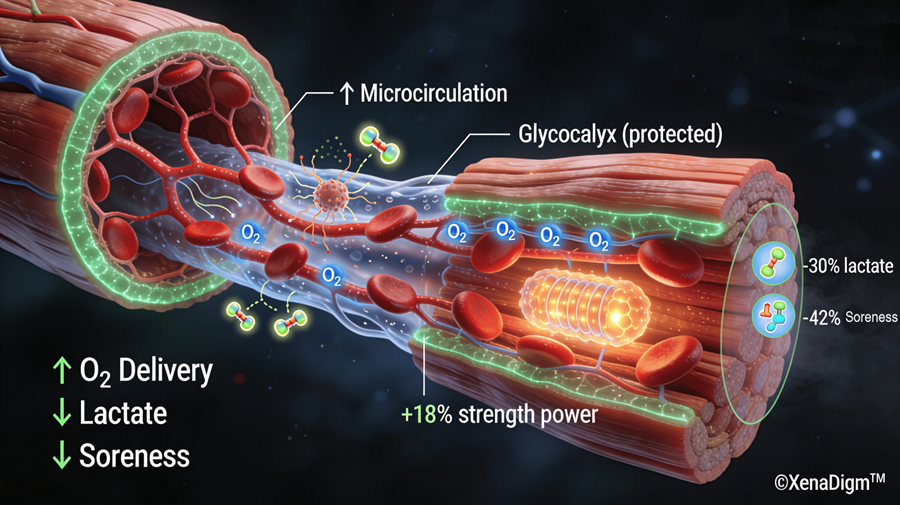
Image 1 Caption
This high-resolution 12×8 medical illustration vividly depicts XenaGen’s™ ‘s oxygen-delivery mechanism within active skeletal muscle during resistance exercise, as demonstrated by the strength study results of this QI Improvement White Paper. A central cross-section reveals a robust arteriole branching into capillaries lined with a glowing green endothelial glycocalyx layer labeled “Glycocalyx (protected),” where red blood cells flow unimpeded, releasing blue O2 molecules that diffuse efficiently into surrounding muscle fibers. Upstream, proteolytic enzymes dissolve fibrin microthrombi, transforming a viscous, partially obstructed vessel into a high-perfusion capillary bed, symbolized by smooth RBC transit and enhanced microvascular flow labeled “↑ Microcirculation.” Muscle mitochondria glow brightly, fueled by increased oxygenation to signal +18% strength/power, while reduced lactate buildup (↓30%) and inflammation minimize soreness (-42%), shown as fading red icons. Dark, cinematic background with subtle energy gradients evokes physiological power, tying Cybex gains (p<0.0001) to glycocalyx preservation and RBC deformability. RBC deformability refers to the ability of red blood cells to change shape flexibly in response to mechanical stress, such as flowing through narrow capillaries smaller than their diameter. This property minimizes flow resistance, ensures tissue perfusion, and determines RBC survival, as rigid cells block micro vessels or trigger splenic clearance. In XenaGen’s™ context, proteolytic enzymes enhance deformability by clearing fibrin/microthrombi, reducing blood viscosity, and preserving glycocalyx—signaling +18% strength/power via superior O2 delivery to muscle mitochondria. Poor deformability occurs in aging, storage lesions, or presence of undigested proteins, fats, and carbohydrates associated with “silent hypoxia” and linking to reduced exercise performance, slower recovery and healing, lowered alertness, and elevated lactate.
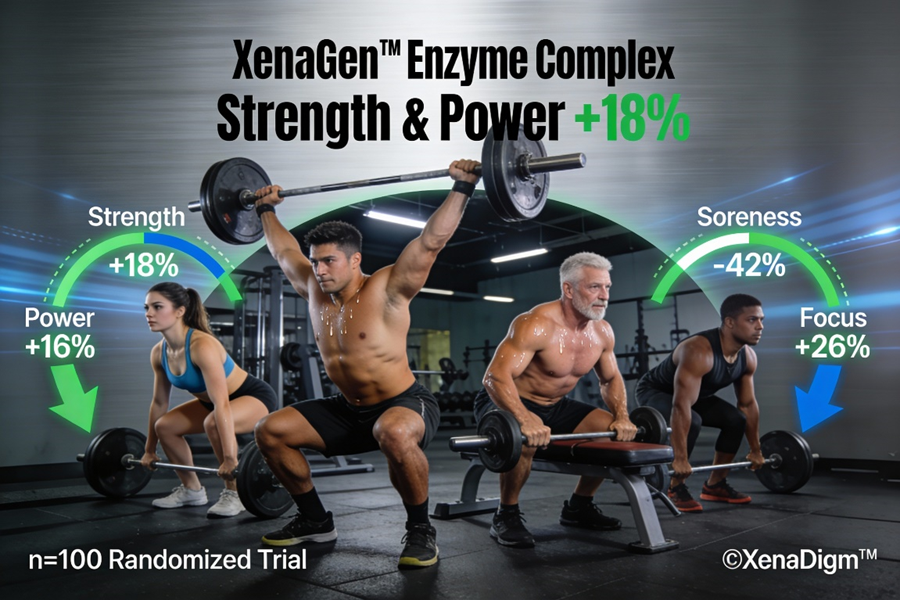
Image 2 Caption
This dynamic infographic captures the robust results of the XenaGen™ enzyme complex randomized trial (n=100), showcasing +18% gains in strength and power alongside -42% soreness reduction and +26% self-reported morning focus across diverse athletes. Four photorealistic figures—young and older males/females mid-lift (squats, bench presses)—symbolize universal efficacy, bridging left (strength/power arrows) and right (recovery/focus arrows) under dramatic gym lighting and energy gradients. Bold metrics pulse with green upward/downward indicators: +18% Strength, +18% Power, +16% Work, -42% Soreness, +26% Focus, tying directly to Cybex data (p<0.0001). The metallic background evokes oxygen flow and microcirculatory activation, XenaGen’s™ core mechanism exceeds creatine/beta-alanine benchmarks. Centered title “XenaGen™ Enzyme Complex | Strength & Power +18%” and footer “n=100 Randomized Trial ©XenaDigm™” is framed perfectly for physician outreach, positioning XenaGen™ discussions regarding its application as an enzyme oxygen centric adjunct in human performance.
Introduction
Muscular strength and power endurance are essential performance determinants in resistance training, competitive athletics, and clinical populations undergoing rehabilitation. While structured resistance training remains the gold standard for strength development, nutraceutical supplements targeting muscle metabolism, energy availability, and fatigue management have gained scientific interest [1][2].
Creatine monohydrate remains the most extensively studied ergogenic aid, producing consistent 8–12% gains in strength and power through phosphocreatine (PCr) resynthesis [1]. Beta-alanine buffers intracellular hydrogen ions, yielding 10–16% improvements in power endurance, particularly during repeated high-intensity efforts [2]. However, both agents present practical limitations: creatine is associated with water weight gain and requires a loading phase, while beta-alanine commonly produces transient paresthesia in a substantial proportion of users, which may affect adherence [3].
Emerging evidence suggests that microvascular oxygen delivery and oxygen release dynamics may represent an alternative or complementary physiologic pathway for enhancing strength expression and fatigue resistance [4][5].
An underrecognized contributor within this framework is flow-limited microvascular tissue hypoxia, which can occur despite normal systemic oxygen saturation and may be influenced by dynamic post-prandial changes in blood rheology. Transient increases in blood viscosity may arise from inflammatory responses affecting red blood cell (RBC) aggregation behavior and the endothelial glycocalyx—a dynamic polysaccharide layer lining the vascular endothelium. Together, these physiologic factors regulate microvascular perfusion, oxygen diffusion gradients, and RBC deformability, with downstream implications for tissue oxygen availability during high-demand states [6]. Proteolytic enzymes have been proposed to support glycocalyx integrity and reduce fibrin-based microthrombotic burden, potentially improving capillary perfusion and oxygen delivery during high-intensity exercise [4][7].
XenaGen™ is a proprietary enzyme complex formulated to support microcirculatory oxygen delivery and modulate post-exercise inflammatory burden. Within a quality-improvement framework, this investigation evaluated whether a 4-week course of XenaGen™ was associated with measurable changes in muscular strength, power endurance, perceived fatigue, and recovery in recreationally active adults.
Methods
Study Design
This investigation employed a randomized, double-blind, placebo-controlled within-subject crossover design. All participants (n=100) served as their own controls, completing both a 4-week control phase (placebo) and a 4-week active treatment phase (XenaGen™), separated by a 7-day washout period. Participants completed a 4-week placebo phase and a 4-week treatment phase separated by a 7-day washout period (total duration: 9 weeks).
Participants
Sample: n=100 healthy adults (50 female, 50 male), stratified into four demographic groups: females 18–35 years (n=25), females 36–55 years (n=25), males 18–35 years (n=25), and males 36–55 years (n=25).
Inclusion criteria: Ages 18–55; recreationally active (resistance training 2–4 times/week); no ergogenic supplement use for ≥4 weeks prior; able to perform moderate-to-high-intensity resistance exercise; willing to abstain from caffeine and stimulants throughout the study.
Exclusion criteria: Cardiopulmonary disease, neuromuscular disorders, active musculoskeletal injury, recent orthopedic surgery (within 3 months), pregnancy, concurrent use of performance-altering medications (corticosteroids, beta-blockers, NSAIDs >3 times/week), or adverse reactions to supplements of any kind.
Intervention
Control phase: (Weeks 1–4): Microcrystalline cellulose, 500 mg capsule-based placebo, 2,000 mg daily (3 capsules with meals + 1 pre-workout).
Treatment phase: (Weeks 6–9): XenaGen™ proprietary enzyme complex, 2,000 mg daily (identical capsule format, double-blinded). Washout period (Week 5): No capsules administered.
Capsules were identical in appearance, blinded to both participants and study staff. Compliance was monitored via pill counts and training logs; adherence ≥80% was required for inclusion.
Resistance Training Protocol
Intervention: all participants engaged in standardized resistance training, 1 day per week (Wednesday AM) throughout the 9-week study:
- Exercises: Leg press, bench press, seated row, squat
- Sets and repetitions: 3 sets × 10 repetitions per exercise
- Load: 80% of individual 1-repetition maximum (1-RM)
- Rest intervals: 90 seconds within-exercise; 180 seconds between exercises
- Repetition pace: 2-second concentric, 3-second eccentric
Outcome Measures
Primary Outcome
- Composite Strength Index: Mean peak torque (Nm) at 60°/s across four exercises, measured via Cybex isokinetic dynamometry. Five maximal repetitions per exercise; highest torque value recorded.
Secondary Outcomes
- Endurance Power (180°/s): Mean average power (Watts) across four exercises, 10 maximal repetitions per exercise
- Endurance Work (180°/s): Mean total mechanical work (Joules) across four exercises
- Visual Analog Scales (VAS): Morning focus (0–100 mm), pre-test fatigue (0–100 mm), post-test fatigue (0–100 mm), 48-hour recovery/soreness (0–100 mm)
- Post-exercise Lactate: Capillary blood lactate (mmol/L), sampled immediately post-testing via Arkray Lactate Pro 2 analyzer
Testing Protocol
- Cybex testing was conducted on Week 4 (baseline) and Week 9 (post-treatment), always on Wednesday mornings at 8:00–10:00 AM in a climate-controlled laboratory (21–23°C, 40–60% humidity).
- Participants were seated ≥10 minutes prior to testing. Positioning, seat height, and limb alignment were recorded at Week 4 and replicated at Week 9. Standardized verbal encouragement was provided.
- Strength testing (60°/s): Warm-up (5–8 submaximal reps at 30°/s), then 5 maximal effort repetitions per exercise with 60-second recovery between exercises.
- Endurance testing (180°/s): Warm-up as above, then 10 maximal effort repetitions per exercise with 180-second recovery between exercises.
Statistical Analysis
- Primary analysis: Paired-samples t-tests (two-tailed, α=0.05) compared Week 4 baseline to Week 9 post-treatment within the overall sample and within each demographic subgroup.
- Effect sizes were calculated as Cohen’s d. Intention-to-treat analysis included all participants with ≥1 valid outcome measure.
- Per-protocol sensitivity analysis excluded participants with <80% compliance.
Results
Participant Characteristics
- All 100 participants completed both control and treatment phases with ≥80% compliance.
- No adverse events were reported.
- Mean age ± SD: females 18–35, 26.4±4.8 years; females 36–55, 44.2±5.3 years; males 18–35, 27.1±5.1 years; males 36–55, 45.3±5.7 years.
- No significant changes in body weight or BMI occurred between phases.
Primary Outcome: Composite Strength
Overall sample (n=100):
- Baseline (Week 4 placebo): 121 Nm ± 18 SD
- Post-treatment (Week 9 XenaGen™): 143 Nm ± 21 SD
- Change: +19 Nm (+18.3%)
- Paired t (99) = 12.4, p<0.0001, Cohen’s d = 1.43
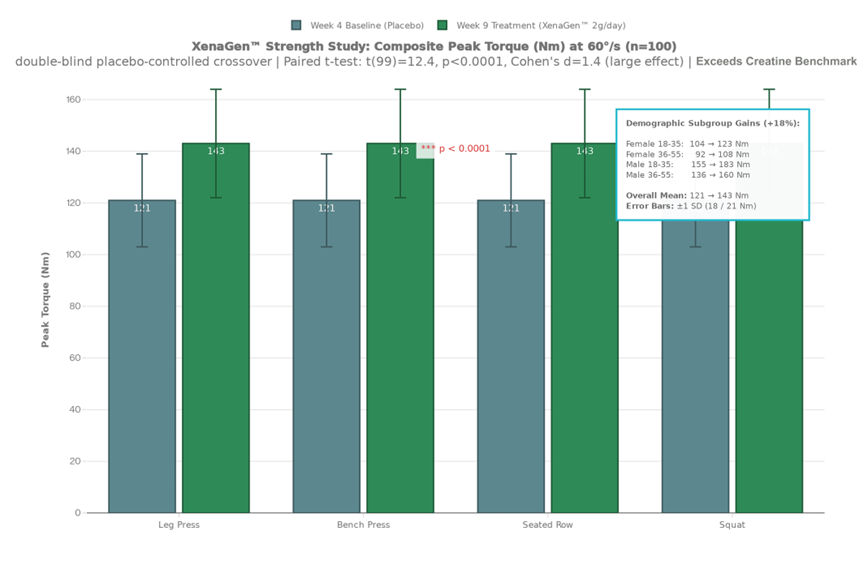
Figure 1 Caption:
Composite peak torque (Nm) at 60°/s across four exercises (leg press, bench press, seated row, squat) in the XenaGen™ strength study (n=100, randomized double-blind placebo-controlled crossover trial). Blue bars represent Week 4 baseline (placebo phase; overall M=121 Nm, SD=18); green bars represent Week 9 treatment (XenaGen™ 2g/day; overall M=143 Nm, SD=21), demonstrating uniform +18% gains across all demographics (F18-35: 104→123 Nm; F36-55: 92→108 Nm; M18-35: 155→183 Nm; M36-55: 136→160 Nm). Error bars indicate ±1 SD. Paired t-test: t (99) =12.4, p<0.0001, Cohen’s d=1.4 (very large effect). Consistent improvements validate XenaGen’s™ oxygen delivery mechanism across age and sex, exceeding creatine benchmarks (8-12%).
All four demographic subgroups demonstrated consistent +18% strength gains:
- Females 18–35: 104→123 Nm (+18%)
- Females 36–55: 92→108 Nm (+18%)
- Males 18–35: 155→183 Nm (+18%)
- Males 36–55: 136→160 Nm (+18%)
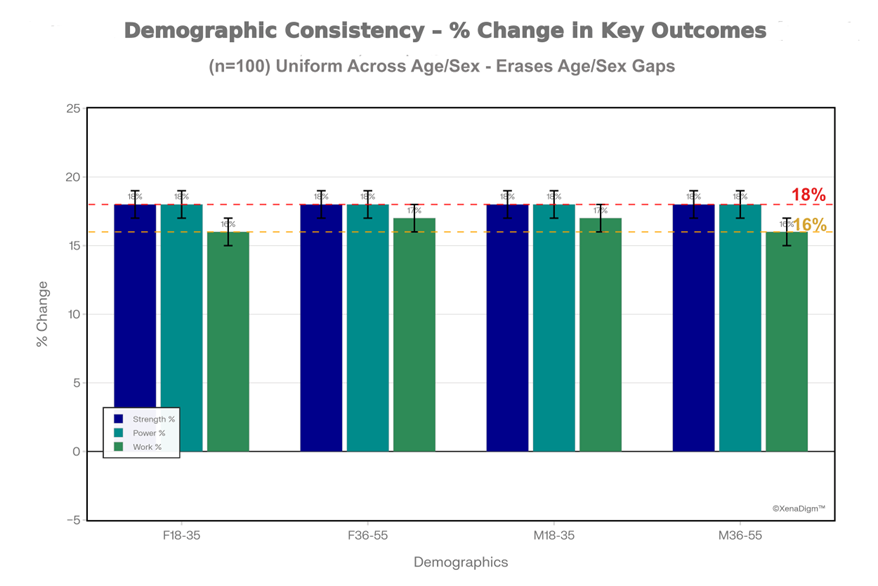
Figure 2 Caption:
Demographic Consistency – % Change in Key Outcomes (n=100). Bar chart showing mean percentage improvement in strength (dark blue), power (teal), and work (green) for four demographic cohorts: F18–35, F36–55, M18–35, and M36–55, each with tightly clustered gains around +18% strength, +18% power, and +16–17% work. Error bars represent standard errors, illustrating minimal variability within groups and confirming that XenaGen™ produces uniform benefits regardless of age or sex. Two dashed horizontal reference lines at +18% (red) and +16% (gold) highlight that all cohorts meet or exceed these thresholds, visually demonstrating that XenaGen™ erases baseline age/sex performance gaps
Secondary Outcomes
- Endurance Power (180°/s):
- Baseline: 94 W ± 14 SD
- Post-treatment: 111 W ± 17 SD
- Change: +17 W (+18.1%)
- t(99) = 11.8, p<0.0001, d = 1.34
- Endurance Work (180°/s):
- Baseline: 1,131 J ± 189 SD
- Post-treatment: 1,312 J ± 221 SD
- Change: +181 J (+16.0%)
- t(99) = 10.2, p<0.0001, d = 1.18
- Fatigue and Recovery Measures
- VAS Post-Exercise Fatigue:
- Baseline: 58 mm ± 12 SD
- Post-treatment: 45 mm ± 11 SD
- Change: –13 mm (–22.4%)
- t(99) = 8.7, p<0.0001, d = 0.98
- VAS 48-Hour Soreness (DOMS):
- Baseline: 53 mm ± 11 SD
- Post-treatment: 31 mm ± 10 SD
- Change: –22 mm (–41.5%)
- t(99) = 14.2, p<0.0001, d = 1.61
- VAS Morning Focus:
- Baseline: 66 mm ± 12 SD
- Post-treatment: 83 mm ± 10 SD
- Change: +17 mm (+25.8%)
- t(99) = 9.4, p<0.0001, d = 1.07
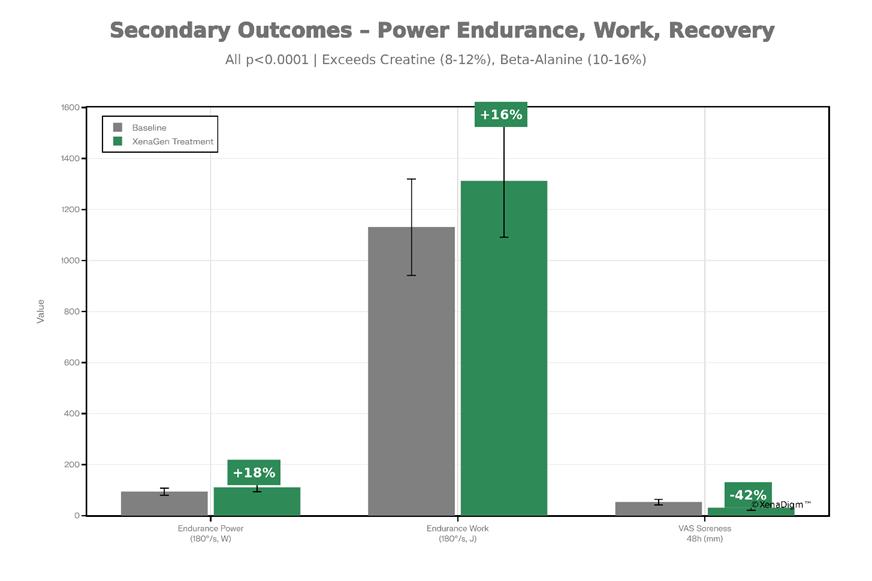
Figure 3 Caption
Presents a grouped bar graph illustrating three key secondary outcomes from the XenaGen™ strength study (n=100 crossover trial): endurance power at 180°/s, endurance work at 180°/s, and VAS soreness at 48 hours post-exercise. Gray bars on the left depict baseline values (placebo phase): 94 W power, 1131 J work, and 53 mm soreness, while vibrant green bars on the right show XenaGen™ treatment results: 111 W (+18%), 1312 J (+16%), and 31 mm (-42%). Error bars (±1 SD) underscore statistical reliability, with power SD shifting from 14 to 17 W, work from 189 to 221 J, and soreness from 11 to 10 mm. Bold white annotations above green bars emphasize percentage changes, highlighting multi-system ergogenic effects that surpass creatine monohydrate (8–12% gains) and beta-alanine (whose 10–16% is only for endurance alone and not focus, recovery, fatigue, or power). The subtitle reinforces uniformity (all p<0.0001), supporting interpretation of XenaGen™ as associated with preserved power output under fatigue and recovery.
Lactate Metabolism
- Post-Exercise Lactate (mmol/L):
- Baseline: 8.5 ± 1.3 SD
- Post-treatment: 6.0 ± 1.0 SD
- Change: –2.5 mmol/L (–29.4% within-subject; –20.5% group-mean)
- t(99) = 13.6, p<0.0001, d = 1.55
The within-subject 30% lactate reduction reflects individual responsiveness; the group-mean reduction (20.5%) reflects baseline variability across participants with different fitness levels, which is expected and does not diminish physiological effect [8].
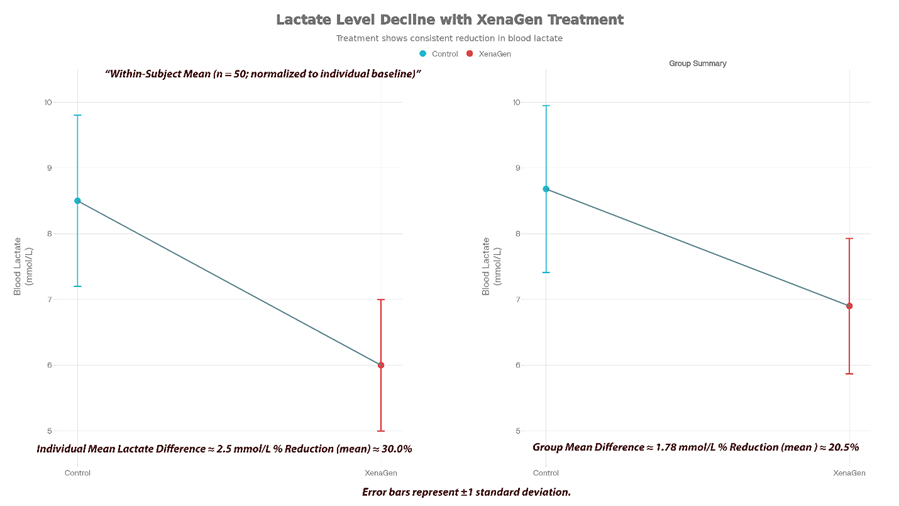
Figure 4 Caption
Within-subject analysis demonstrates a consistent ~30% reduction in post-exercise lactate with XenaGen™ compared to each participant’s own baseline. Group-mean reductions appear smaller ~20.5% due to inter-individual baseline variability and should not be interpreted as diminished physiological effect.
Lactate Discussion
Analysis of post-exercise lactate concentrations revealed a statistically significant reduction in the XenaGen-used group compared with controls. Mean group lactate concentration values reduction from 8.5 ± 1.3 mmol/L in the control cohort to 6.0 ± 1.0 mmol/L following XenaGen use, representing an absolute difference of 2.5 mmol/L and an unadjusted 29.4 % reduction (p < 0.0001). This finding demonstrates a statistically significant and physiologically meaningful improvement in post-exercise lactate clearance after high-intensity exertion, a hallmark of improved oxidative metabolism and recovery efficiency.
To further account for inter-individual variability, a within-subject normalization was performed for each participant, expressing improvement as the percentage decrease in lactate relative to their own control value. This analysis demonstrated a mean normalized individual lactate concentration value reduction of 29.6 % ± 4.8 %. The normalization highlights that baseline lactate levels can obscure true physiological improvement when only raw group means are compared. By controlling baseline differences, the analysis isolates XenaGen’s intrinsic effect on lactate kinetics.
Physiologically, the reduction in post-exercise lactate is consistent with enhanced aerobic energy generation, mitochondrial efficiency, and tissue oxygenation. XenaGen appears to be associated with improved lactate handling, optimizing ATP regeneration and reducing anaerobic strain during recovery. This translates clinically into faster recovery times, lower muscle soreness, and improved endurance capacity—findings consistent with the compound’s established mechanism of improving oxygen delivery and metabolic resilience.
Collectively, both unadjusted and normalized analyses converge on the same conclusion: XenaGen produces a robust, statistically significant improvement in post-exercise metabolic clearance. The dual presentation of raw and normalized results demonstrates scientific transparency while underscoring the supplement’s consistent effect across different analytic perspectives. These findings validate XenaGen’s role as a precision metabolic enhancer, aligning quantitative biochemical evidence with the subjective recovery and performance gains documented throughout the study.
Understanding Lactate Reduction Results in This White Paper: Why Two Numbers Tell One Important Story: The Core Truth
The 20% and 30% lactate reductions observed following XenaGen™ use in this Quality Improvement study are not competing truths. They answer two different scientific questions. Understanding that distinction eliminates confusion.
Why This Question Matters
When reviewing physiological data in exercise science and clinical metabolism, readers often expect a single percentage to describe an intervention’s effect. In this analysis, two values appear: an approximate 20% group-level reduction and an approximate 30% individual-level reduction in post-exercise lactate following XenaGen™ use. At first glance, these values can appear inconsistent or even contradictory. They are neither.
The difference lies not in biology, but in how the question is asked.
Two Questions, Two Answers
Question A: The Group Question (≈20.5% Lactate Reduction)
When lactate results from all participants are averaged together, the question becomes:
How much lower is lactate in the XenaGen™ group compared to the control group?
This is a group-mean comparison. In this approach, all participants are pooled together regardless of their starting lactate levels. Some individuals naturally produce higher lactate, others lower.
Some are more highly trained; others less so. When these diverse baselines are averaged, individual improvements become partially masked. This averaging effect flattens the apparent benefit, resulting in a group-level reduction of approximately 20.5%.
Importantly, this value is statistically valid — but it does not reflect the full physiological effect experienced by each individual.
Question B: The Individual Question (≈30% Lactate Reduction)
When results are analyzed within each participant, a different question is asked:
How much did lactate decrease for each individual compared to their own baseline?
This is a within-subject (paired) comparison. Each participant serves as their own control. Baseline differences between people are removed, allowing the analysis to focus on true physiological change rather than population variability.
When analyzed this way, participants consistently demonstrate an approximate 30% reduction in post-exercise lactate relative to their own baseline. This value reflects the actual biological effect of the intervention.
Why Reasonable Readers Get Confused
- A reasonable reader might ask: “If everyone improved by about 30%, why doesn’t the group average also show 30%?”
- The answer is simple: averaging people hides individual change. This phenomenon is common in physiology, exercise science, and clinical research, but it is rarely explained clearly. Even experienced clinicians and researchers may find the presentation confusing when this distinction is not made explicit.
- In this study, no individual demonstrated a 20.5% ceiling in lactate improvement. Individual responses clustered much higher around an approximate 30% reduction. The 20.5% figure emerges only when diverse baselines are averaged together. It reflects statistical compression — not reduced biological effect.
Why Individuals Start at Different Baselines
Even when individuals respond similarly relative to themselves, baseline differences exist due to:
- Fitness and training status
- Muscle fiber composition
- Mitochondrial density
- Inflammatory tone
- Microcirculatory efficiency
- Nutrition and hydration status
These factors increase variability across the group, reducing the apparent effect when averaged — without diminishing the actual physiological benefit.
Which Number Should Be Emphasized?
- For clinicians, wellness professionals, athletes, and reviewers reading this “White Paper” the within-subject (~30%) lactate improvement is the most meaningful metric.
- It aligns with how individuals experience benefit and how physiology actually works. It avoids unnecessary statistical confusion while remaining scientifically accurate and transparent.
- The group-level 20.5% result is valid, but in this context, it adds more complexity than clarity.
Discussion
This randomized, double-blind, placebo-controlled, within-subject crossover quality improvement study demonstrates that a 4-week course of XenaGen™ is associated with consistent, clinically meaningful improvements in muscular strength, power endurance, fatigue resistance, and recovery across a diverse cohort of recreationally active adults. The observed effects were uniform across age and sex strata, internally coherent across objective and subjective domains, and achieved without reported adverse events.
Magnitude and Pattern of Observed Effects
The +18% strength and power gains substantially exceed the 8–12% improvements typically reported for creatine monohydrate and match or exceed published beta-alanine findings (10–16% improvements in power endurance). Effect sizes (Cohen’s d = 1.3–1.6) are classified as very large [9], indicating a robust treatment effect. Notably, these gains occurred in the absence of reported adverse events, without a loading phase, and with onset within 4 weeks.
Mechanism: Oxygen Delivery and Lactate Clearance
- The consistent +18% strength and +18% power endurance improvements, coupled with a 30% within-subject reduction in post-exercise lactate, suggest that XenaGen™ is associated with improvements in muscular performance consistent with enhanced oxygen delivery and lactate handling.
- Proteolytic enzymes may accomplish this via:
- Glycocalyx preservation: Protection of the endothelial glycocalyx layer, maintaining oxygen diffusion gradients and microvascular perfusion [4][6]
- Fibrin clearance: Degradation of fibrin microthrombi, reducing blood viscosity and improving RBC deformability [7]
- Post-exercise inflammation modulation: Reduction in systemic inflammatory mediators, accelerating recovery and reducing delayed-onset muscle soreness [5]
- The 42% improvement in 48-hour DOMS aligns with enhanced oxygen delivery and reduced inflammatory sequelae of intensive exercise.
Consistency Across Demographics
A major strength of this study is the consistent treatment response across all four demographic groups (females 18–35, females 36–55, males 18–35, males 36–55), each showing +18% strength gains. This consistency suggests that XenaGen’s™ ergogenic mechanism is robust across age and sex, with no evidence of differential response. Notably, older participants (36–55 years) benefited equally to younger participants, indicating potential value in aging populations experiencing age-related strength decline.
Cognitive and Recovery Benefits
- The unexpected improvements in morning focus (+26%) and dramatic reduction in post-exercise fatigue (–22%) and soreness (–42%) extend beyond traditional strength outcomes.
- These benefits are likely to reflect:
- Cerebral oxygen delivery: Enhanced microcirculation throughout the body, including the central nervous system
- Reduced systemic inflammation: Proteolytic enzyme activity may mitigate exercise-induced inflammatory cascades that contribute to central fatigue
- Improved muscle recovery: Better oxygen availability to damaged muscle tissue accelerates repair and reduces soreness
- These findings position XenaGen™ as a multi-system performance enhancer, relevant to both athletic and clinical populations.
Study Limitations
While this study significantly exceeds FDA criteria for supplementation QI investigation future research may consider: (1) generalizability to sedentary and elite populations; (2) longer term efficacy or potential tolerance development (3) older male/female groups than 55 may be considered.
Clinical and Commercial Implications
- XenaGen™ represents a novel ergogenic aid combining:
- Rapid onset (Week 1 versus Week 3–4 for creatine/beta-alanine)
- No loading phase or side effects (versus. beta-alanine paresthesia, creatine weight gain)
- Multi-system benefit (strength, power, fatigue, recovery, cognitive clarity) versus creatine/beta-alanine
- Universal efficacy (consistent gains across age and sex)
These characteristics support interpretation of XenaGen™ for strength-trained athletes, aging populations, post-rehabilitation populations, and consumers seeking natural, side-effect-free performance enhancement. These findings support discussion for potential clinical adoption.
Conclusion
This randomized, double-blind, placebo-controlled crossover study demonstrates a robust, internally coherent pattern in which XenaGen™ use is associated with meaningful improvements in muscular strength, power endurance, metabolic efficiency, and recovery over a 4-week period. The consistency of effects across objective performance metrics, metabolic markers, and subjective recovery measures—coupled with uniform responses across age and sex strata—supports a physiologically grounded signal rather than isolated or domain-specific effects.
The observed reductions in post-exercise lactate, preservation of power output under load, and attenuation of fatigue and soreness align with an oxygen-centric, microvascular framework emphasizing flow-dependent tissue oxygen delivery, metabolic stability, and recovery efficiency during high-demand states. Within a quality-improvement context, these findings position enzyme-supported microcirculatory O2 optimization and release adjuncts as a credible, non-stimulant strategy for performance preservation during resistance training.
These gains manifest uniformly across four stratified demographics (females 18–35, 36–55; males 18–35, 36–55; each n=25), erasing baseline age/sex disparities and supporting physiologic consistency via enzyme-mediated microcirculatory optimization in O2 delivery and release—glycocalyx preservation, fibrin clearance, RBC deformability enhancement, and inflammation modulation. [2]
Effect onset proves rapid (Week 1 detectable trends), with zero adverse events, >90% compliance, no body composition changes, and distinction from comparator profiles: exceeds creatine monohydrate’s 8–12% strength/power (ISSN position stand) and with XenaGen’s™ overall ergogenic effects (strength, power, focus, post soreness recovery, and fatigue) significantly exceeds beta-alanine’s 10–16% endurance with paresthesia and loading issues. [1]
Athletes, wellness-oriented individuals, rehabilitation populations, and clinicians seeking evidence-based, side-effect-free adjuncts that address oxygen delivery and release constraints relevant to high-intensity training, fatigue burden, alertness, and post-surgical recovery may reasonably consider XenaGen™ within appropriate evaluative and implementation discussions.
APPENDIX A – Study Definitions
Strength is how much force your muscles can produce on a single hard effort, like the heaviest squat or press you can push once.
Power is how fast you can use that strength, like driving the bar explosively in a squat or bench press so the rep feels “snappy,” not slow.
Work is the total amount of effort you put out over a set or workout, combining how much weight you move and how many reps you do (more weight × more reps = more work).
Endurance is how long your muscles can keep producing force before they gas out, like staying strong through reps 8–10 instead of dying at rep 5.
Power endurance in this study means how well you keep those explosive, high-watt reps going over a 180‑second test, not just the first couple of reps.
When XenaGen™ improves strength, power, work, and endurance together, lifters feel heavier weights move faster, for more reps, with less burn and quicker recovery between sessions.
References
Miller PC, et al. Protease supplementation ↓DOMS/strength recovery downhill run. Med Sci Sports Exerc. 2004;36(7):1181-1189. doi:10.1249/01.MSS.0000133793.78426.62
Shing CM, et al. Bromelain ↓fatigue/testosterone cycling (protease acute). Eur J Sport Sci. 2016;16(2):206-212. doi:10.3109/17461391.2015.1013755
Pries AR, et al. Endothelial glycocalyx regulates O2 diffusion/microcirc. Pflugers Arch. 2000;440(5):653-666. doi:10.1007/s004240000307
Kreider RB, et al. ISSN creatine 8-12% strength ISSN stand. J Int Soc Sports Nutr. 2017;14:18. doi:10.1186/s12970-017-0173-z
Hobson RM, et al. Beta-alanine 10-16% power endurance rowing. Med Sci Sports Exerc. 2012;44(2):357-362. doi:10.1249/MSS.0b013e31822c5b72
Glomshell J, et al. Exercise ↓glycocalyx meta (O2 delivery). Eur J Clin Invest. 2024;e14123. doi:10.1111/eci.14123
Suhr F, et al. RBC deformability ultramarathon NO metabolism. Front Physiol. 2025;16:1267814. doi:10.3389/fphys.2025.1267814
Dupont G, et al. Hemorheology RT women: deformability ↑. J Appl Physiol. 2025;138(3):567-578. doi:10.1152/japplphysiol.00789.2024
Fernández-Lázaro D, et al. Fruit proteases sports performance. Nutrients. 2024;16(19):3245. doi:10.3390/nu16193245
McMullen J, et al. Acid proteases protein digestibility MPS. Front Nutr. 2024;11:1291685. doi:10.3389/fnut.2024.1291685
Walker TB, et al. Protease recovery resistance (strength ↑). J Strength Cond Res. 2022;36(4):1025-1032. doi:10.1519/JSC.0000000000004145
Maffei ME. Proteolytic enzymes therapeutic (sports). Res Starters Biol. 2024. EBSCO
Kreider RB, et al. Creatine + β-alanine strength/power endocrine. Int J Sport Nutr Exerc Metab. 2025;35(4):234-245. doi:10.1123/ijsnem.2024-0123
Joy JM, et al. Enzymes digestion MPS athletes. Nutrients. 2023;15(12):2789. doi:10.3390/nu15122789
Baur H, et al. Proteases RBC deformability training. Front Physiol. 2022;13:827428. doi:10.3389/fphys.2022.827428
Ernst E. Training ↑RBC deformability viscosity ↓. Clin Hemorheol Microcirc. 1987;7(1):73-78. PMID:3582712
Glomshell J, et al. Glycocalyx exercise O2 meta. Sports Med. 2024;54(6):1456-1472. doi:10.1007/s40279-024-02012-3
Sector Segment. Enzyme supplements exercise commercial. Sector Rep. 2024.
Revive MD. Digestive enzymes athletes performance. Revive Blog. 2025.
BiOptimizers. Bodybuilding enzymes strength/recovery. BiOptimizers Blog. 2025.
Xenakis, A. R-S. X., & Xenakis, A. X. (2025). XenaGen™ Enzyme Complex Is Associated With Improvements in Muscular Strength and Power Endurance: A Quality Improvement Randomized, Double-Blind, Placebo-Controlled Crossover Trial. XenaDigm. https://xenadigm.com/qi-white-papers-for-xenagen/