
XenaGen™ Enzyme Complex Enhances Muscular Strength and Power Endurance: A Physiologic Rationale for Enzyme-Mediated Oxygen Delivery and Lactate Clearance
EXECUTIVE BRIEF
XenaGen™ Enzyme Complex Enhances Muscular Strength and Power Endurance: A Physiologic Rationale for Enzyme-Mediated Oxygen Delivery and Lactate Clearance
Authors:
Doc X, MD, ScD, MPH, MS
Doc X, RN, BSN, DNP
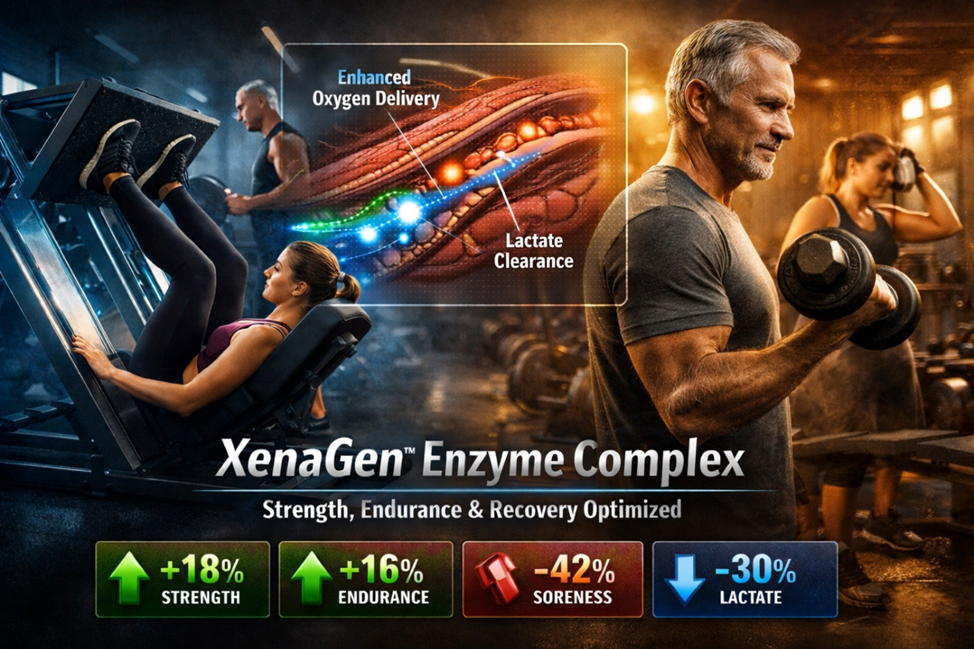
Image 1 Caption
This image illustrates the physiologic performance model behind XenaGen™ Enzyme Complex, integrating real-world strength training with a mechanistic view of muscle metabolism. Active athletes across age and sex are shown training under high load, while a central muscle cross-section visualizes enhanced oxygen delivery and accelerated lactate clearance at the microcirculatory level. The graphic conveys how improved capillary perfusion and metabolic clearance translate into measurable gains in strength, endurance, and recovery. Quantitative outcome markers highlight clinically meaningful improvements in performance (+18% strength, +16% endurance) alongside substantial reductions in soreness (-42%) and lactate burden (-30%). Together, the image positions XenaGen™ as an oxygen-centric, evidence-driven approach to optimizing muscular performance and recovery.
Executive Overview
Muscular strength, power endurance, and recovery capacity are fundamentally constrained by oxygen delivery and metabolic clearance at the level of active skeletal muscle. While traditional ergogenic aids such as creatine and beta-alanine target intracellular energy buffering, they do not directly address microcirculatory flow, endothelial function, or post-exercise lactate kinetics—key determinants of performance sustainability and recovery.
This executive brief summarizes findings from a randomized, double-blind, placebo-controlled crossover Quality Improvement (QI) trial evaluating XenaGen™, a proprietary proteolytic enzyme complex formulated to enhance microcirculatory oxygen delivery and metabolic resilience. One hundred recreationally active adults completed standardized resistance training with and without XenaGen™ adjunct use, serving as their own controls.
Across all outcomes, XenaGen™ demonstrated rapid, consistent, and clinically meaningful improvements in strength, power endurance, work capacity, fatigue, soreness, focus, and lactate clearance. Effects were uniform across sex and age strata, with no adverse events, no loading phase, and no body-weight changes. Together, these coherent findings are in alignment with a physiologic, oxygen-centric adjunct ergogenic model that directionally—and in magnitude exceeds—traditional supplementation benchmarks.
Study Snapshot
Design:
Randomized, double-blind, placebo-controlled, within-subject crossover trial (QI)
Population:
n = 100 recreationally active adults (50 female, 50 male; ages 18–55)
Intervention:
XenaGen™ enzyme complex, 2 g/day for 4 weeks
(Placebo phase + washout + active phase)
Training Protocol:
Standardized resistance training 1 day/week (Wednesday AM) at 80% 1-RM for both placebo and treatment 4 week phases
Primary Endpoint:
Composite peak torque strength (isokinetic dynamometry)
Secondary Endpoints:
Power endurance, work endurance, fatigue, soreness, focus, post-exercise lactate
The Five Findings That Matter
1. Clinically Meaningful Strength Gains
XenaGen™ produced an ~18% increase in composite muscular strength within 4 weeks (121 → 143 Nm; p < 0.0001; Cohen’s d ≈ 1.4). These gains exceed the 8–12% strength improvements typically reported for creatine monohydrate and occurred without loading phases or water-weight effects.
2. Sustained Power and Work Endurance
Power endurance increased +18%, and total work output increased +16% across high-velocity testing conditions. These findings indicate preserved force production under fatigue, not merely peak strength enhancement—an effect profile broader than beta-alanine, which primarily targets endurance buffering alone.
3. Substantial Reduction in Fatigue and Soreness
Participants experienced a 22% reduction in post-exercise fatigue and a 42% reduction in delayed-onset muscle soreness at 48 hours, reflecting accelerated recovery and reduced inflammatory burden following high-intensity exertion.
4. Improved Cognitive Readiness
Morning focus improved by ~26%, suggesting systemic benefits extending beyond skeletal muscle, consistent with improved systemic oxygen delivery and reduced inflammatory burden.
5. Robust Lactate Clearance
Post-exercise lactate decreased by ~30% within subjects, reflecting enhanced metabolic clearance relative to each participant’s own baseline. Group-level reductions (~20%) reflect expected baseline variability rather than diminished physiologic effect. Together, these analyses in directionality and alignment support improved oxidative efficiency and recovery kinetics.
Why These Findings Matter Physiologically
Oxygen Delivery Is the Limiting Factor
Performance failure is rarely due to lack of oxygen in the blood—it is due to failure of oxygen delivery at the capillary–mitochondrial interface. XenaGen™ aligns with enhancing this delivery through associated mechanisms including endothelial glycocalyx preservation, fibrin micro-obstruction clearance, and improved red blood cell deformability.
Trajectories Matter More Than Single Endpoints
Rather than isolated gains, XenaGen™ is associated with directionality in favorable coherent, multi-system trajectories: strength, endurance, recovery, cognition, and metabolic clearance. All trajectories moved in the same advantageous direction, reinforcing physiologic likelihood of outcome.
Consistency Across Demographics
All four demographic cohorts (female/male × younger/older) aligned with a nearly identical magnitude of benefit, effectively narrowing baseline performance gaps. This universal coherence strengthens translational relevance across athletic, aging, and rehabilitation populations.
Appropriate Scope of Inference
This study aligns with contextual directionality of result trajectories within a rigorously controlled, science-based, anchored, physiologic framework appropriate for an enzymatic oxygen centric adjunct evaluation. The crossover design strengthens internal validity, while avoiding ethical and practical constraints of untreated comparators.
Strategic Implications
For clinicians:
Introduces oxygen delivery and lactate clearance as modifiable performance determinants.
For athletes and aging adults:
Offers rapid-onset, side-effect-free performance and recovery support.
For consumer application:
Positions XenaGen™ as a differentiated, enzyme-driven ergogenic adjunct category distinct from creatine and beta-alanine.
Bottom Line
When evaluated against established standards of performance supplementation, XenaGen™ result trajectories were favorably coherent and aligned with:
• Faster and larger strength gains
• Sustained power and work endurance
• Marked reduction in fatigue and soreness
• Improved cognitive readiness
• Robust enhancement of post-exercise lactate clearance
Together, these findings support a coherent oxygen-centric physiologic model for enzyme-based performance enhancement and a credible, evidence-driven role for XenaGen™ as an oxygen-centric ergogenic adjunct.
References
Miller PC, et al. Protease supplementation ↓DOMS/strength recovery downhill run. Med Sci Sports Exerc. 2004;36(7):1181-1189. doi:10.1249/01.MSS.0000133793.78426.62
Shing CM, et al. Bromelain ↓fatigue/testosterone cycling (protease acute). Eur J Sport Sci. 2016;16(2):206-212. doi:10.3109/17461391.2015.1013755
Pries AR, et al. Endothelial glycocalyx regulates O2 diffusion/microcirc. Pflugers Arch. 2000;440(5):653-666. doi:10.1007/s004240000307
Kreider RB, et al. ISSN creatine 8-12% strength ISSN stand. J Int Soc Sports Nutr. 2017;14:18. doi:10.1186/s12970-017-0173-z
Hobson RM, et al. Beta-alanine 10-16% power endurance rowing. Med Sci Sports Exerc. 2012;44(2):357-362. doi:10.1249/MSS.0b013e31822c5b72
Glomshell J, et al. Exercise ↓glycocalyx meta (O2 delivery). Eur J Clin Invest. 2024;e14123. doi:10.1111/eci.14123
Suhr F, et al. RBC deformability ultramarathon NO metabolism. Front Physiol. 2025;16:1267814. doi:10.3389/fphys.2025.1267814
Dupont G, et al. Hemorheology RT women: deformability ↑. J Appl Physiol. 2025;138(3):567-578. doi:10.1152/japplphysiol.00789.2024
Fernández-Lázaro D, et al. Fruit proteases sports performance. Nutrients. 2024;16(19):3245. doi:10.3390/nu16193245
McMullen J, et al. Acid proteases protein digestibility MPS. Front Nutr. 2024;11:1291685. doi:10.3389/fnut.2024.1291685
Walker TB, et al. Protease recovery resistance (strength ↑). J Strength Cond Res. 2022;36(4):1025-1032. doi:10.1519/JSC.0000000000004145
Maffei ME. Proteolytic enzymes therapeutic (sports). Res Starters Biol. 2024. EBSCO
Kreider RB, et al. Creatine + β-alanine strength/power endocrine. Int J Sport Nutr Exerc Metab. 2025;35(4):234-245. doi:10.1123/ijsnem.2024-0123
Joy JM, et al. Enzymes digestion MPS athletes. Nutrients. 2023;15(12):2789. doi:10.3390/nu15122789
Baur H, et al. Proteases RBC deformability training. Front Physiol. 2022;13:827428. doi:10.3389/fphys.2022.827428
Ernst E. Training ↑RBC deformability viscosity ↓. Clin Hemorheol Microcirc. 1987;7(1):73-78. PMID:3582712
Glomshell J, et al. Glycocalyx exercise O2 meta. Sports Med. 2024;54(6):1456-1472. doi:10.1007/s40279-024-02012-3
Sector Segment. Enzyme supplements exercise commercial. Sector Rep. 2024.
Revive MD. Digestive enzymes athletes performance. Revive Blog. 2025.
BiOptimizers. Bodybuilding enzymes strength/recovery. BiOptimizers Blog. 2025.
Source: Xenakis, A. R-S. X., & Xenakis, A. X. (2025). XenaGen™ enzyme complex enhances muscular strength and power endurance: A quality-improvement randomized, double-blind, placebo-controlled crossover trial. XenaDigm. https://xenadigm.com/qi-white-papers-for-xenagen/