
Composite Case Study/White Paper
An Oxygen-Centric, Non-Stimulant Adjunct in Peripheral Vascular Disease: A Composite Case Study – Based White Paper on Symptom Relief, Functional Recovery, and Microcirculatory Perfusion
Prepared by: ©The Decision Docs™
Authors:
Doc X, MD, ScD, MPH, MS
Doc X, RN, BSN, DNP
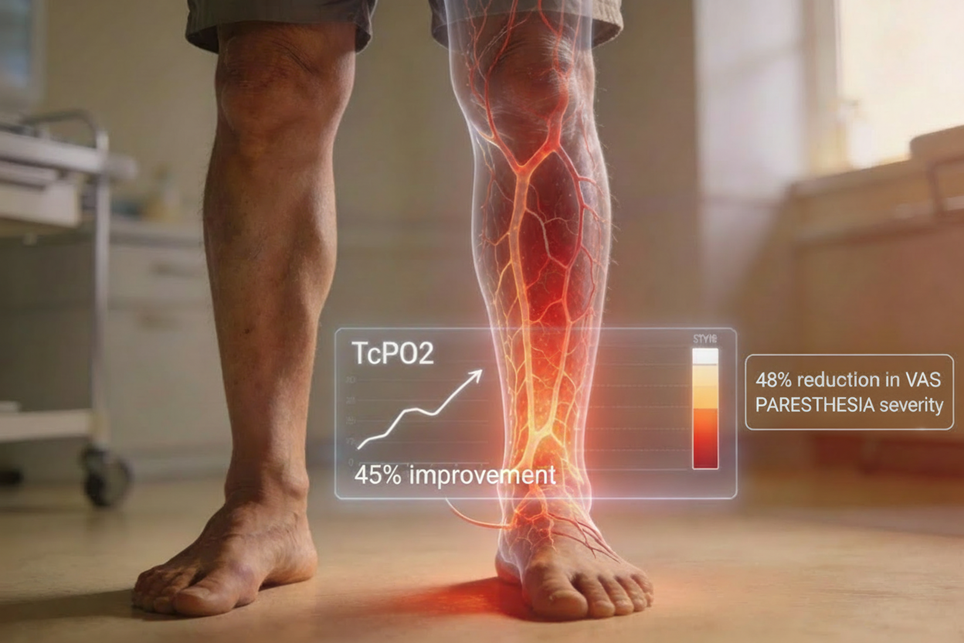
Image 1 Caption:
This image illustrates the clinical impact of an oxygen-centric, non-stimulant adjunct in peripheral vascular disease (PVD), featuring a standing patient’s lower extremities with warm, healthy skin tones. A semi-transparent microvascular overlay reveals enhanced capillary perfusion and robust blood flow, transitioning from narrowed vessels to optimized microcirculation. Integrated digital overlays highlight key perfusion metrics: a TcPO2 graph trending upward with “45% improvement” and a badge noting “48% reduction in VAS PARESTHESIA severity.” These quantitative indicators, drawn from the composite case study, underscore temporal improvements in tissue oxygenation and symptom relief over six weeks without stimulant side effects. The composition emphasizes physiologic recovery, improved walking tolerance, and microcirculatory gains, aligning with the white paper’s findings-based rationale for consideration of the use of oxygen centric adjunctive strategies in PVD care.
Abstract
Peripheral vascular disease (PVD) is characterized by impaired microcirculatory perfusion and reduced tissue-level oxygen delivery, which can contribute to downstream sensory disturbance, functional limitation, and early claudication even in the absence of critical limb ischemia. While standard management emphasizes risk-factor modification, exercise therapy, and revascularization when indicated, a subset of patients experience persistent symptom burden and activity limitation despite stable standard-of-care treatment.
This white paper presents a composite, educational quality-improvement case derived from aggregated observations in four middle-aged adults with moderate PVD who received an oxygen-centric, non-stimulant adjunct (XenaGen™) alongside standard care. Over a six-week observation period, improvements were observed in transcutaneous oxygen pressure (TcPO₂), walking tolerance, claudication status, and distal paresthesia severity, without stimulant-associated cardiovascular or sleep-related adverse effects.
The convergence of perfusion metrics, functional outcomes, and sensory symptom changes supports the plausibility of a microcirculatory, physiology-first model centered on enhanced tissue oxygen delivery and release rather than arousal-based symptom masking. Within an observational, non-causal framework, these findings provide a disciplined rationale for continued structured investigation of oxygen-centric, non-stimulant adjunctive strategies in vascular-compromised populations.
Background
Peripheral vascular disease remains a prevalent cause of morbidity, particularly in middle-aged and older adults with metabolic or cardiovascular risk factors. Even in the absence of critical limb ischemia, patients commonly experience distal paresthesia, reduced walking tolerance, nocturnal symptoms, and early claudication. These symptoms often persist despite appropriate pharmacologic management, lifestyle modification, and supervised exercise programs.
Current adjunctive strategies aimed at improving perceived energy or activity tolerance frequently rely on stimulatory mechanisms, which may be inappropriate in vascular-compromised populations due to cardiovascular strain, sleep disruption, or autonomic side effects. There is therefore growing interest in approaches that support tissue oxygen availability and microcirculatory function without relying on sympathetic activation.
Purpose and Scope
The purpose of this white paper is to examine, through a rigorously framed composite case, whether an oxygen-centric, non-stimulant adjunct may be associated with clinically meaningful improvements in sensory symptoms, functional capacity, and perfusion markers in individuals with moderate PVD. The case is presented for educational and scientific discussion only and does not represent a clinical trial or a single patient experience.
Methods: Composite Case Construction
This white paper is based on an educational composite case representing four middle-aged adults (two female, two male) with established peripheral vascular disease. The case was constructed from aggregated observations to reflect common clinical patterns while avoiding any identifying features.
A non-stimulant, oxygen-centric adjunct was incorporated alongside existing management over a six-week observation period, with no changes to stimulant exposure, medications, or lifestyle interventions.
Sensory symptom burden, including distal paresthesia severity, was assessed using a standardized visual analog scale (VAS), with within-participant changes tracked longitudinally across the observation period.
Transcutaneous oxygen pressure (TcPO₂, mmHg) was measured at the calf, providing a functional assessment of tissue-level oxygen diffusion from capillary beds into surrounding tissue.
Walking tolerance and claudication were evaluated using the 6-minute walk test.
Baseline Characteristics (Pre-Adjunct)
At baseline, individuals demonstrated:
- Clinical features consistent with moderate PVD without critical limb ischemia
- Diminished but palpable distal pedal pulses
- Cool lower-extremity skin temperature and mildly delayed capillary refill
- No ulceration, tissue breakdown, or gangrene
Functionally, individuals reported:
- Persistent distal paresthesia at rest, frequently worse at night
- Early intermittent claudication requiring rest after short walking distances
- Reduced walking tolerance and sleep disruption
Symptoms persisted despite stable standard-of-care management, including risk-factor control and lifestyle guidance.
Intervention Context
XenaGen™ was introduced as a non-stimulant, oxygen-centric adjunct at a dose of 500 mg three times daily, in addition to ongoing standard management for PVD. No stimulant agents were initiated or escalated during the observation period, and lifestyle and medical therapies remained otherwise stable.
Observed Clinical Patterns
Perfusion Metrics (Microvascular Oxygen Delivery & Release)
Transcutaneous oxygen pressure (TcPO₂) demonstrated an approximate 45% endpoint improvement from week one to week six. Clinical examination findings—including warmer extremities, improved capillary refill, and more symmetric perfusion—aligned temporally with TcPO₂ changes, supporting internal concordance between objective perfusion measures and bedside assessment.
Functional Capacity and Claudication (Aerobic Performance)
Walking tolerance improved progressively over the six-week observation period. Claudication symptoms resolved to absence by week six, as assessed through standardized six-minute walking evaluations, with a reduced need for rest during ambulation reported across the composite group.
Sensory Symptoms (Downstream Functional Consequence)
Using a standardized visual analog scale (VAS), paresthesia severity decreased by approximately 20% within the first week and demonstrated an average 48% reduction by week six, reflecting attenuation of distal sensory symptom burden over time.
Safety and Tolerability
Importantly, no increases in heart rate, blood pressure instability, jitter, restlessness, or sleep disruption were observed during the observation period.
Clinical Interpretation
Within an observational framework, the observed pattern of improvement is consistent with a physiologic model centered on enhanced tissue-level oxygen delivery and release, as reflected by parallel improvements in transcutaneous oxygen pressure (TcPO₂) and bedside perfusion findings. These upstream microcirculatory changes provide a plausible physiologic foundation for downstream functional and sensory outcomes.
Improved oxygen availability and release at the tissue level may support aerobic skeletal muscle performance, contributing to progressive gains in walking tolerance and resolution of early claudication during ambulation. In parallel, attenuation of distal paresthesia severity is consistent with reduced ischemia-associated sensory burden rather than symptomatic override.
Importantly, these changes occurred without evidence of sympathetic activation, arousal-based stimulation, or sleep disruption, distinguishing this pattern from stimulant-mediated approaches that temporarily mask fatigue or discomfort rather than supporting underlying physiologic substrates.
Collectively, the coherent temporal alignment between perfusion metrics, functional capacity, and sensory symptom improvement reinforces a physiology-first interpretation grounded in preservation and stabilization rather than stimulation.

Image 2 Caption
This image depicts a clinical consultation focused on peripheral vascular health, combining realistic patient–physician interaction with a detailed visualization of lower-extremity vasculature. In the foreground, a clinician reviews a high-resolution digital rendering of leg arteries on a tablet, visually linking diagnostic insight with bedside decision-making. The translucent overlay of arteries and microvasculature along the patient’s leg emphasizes blood flow, oxygen delivery, and microcirculatory function as central themes. The calm clinical environment and attentive posture of both clinician and patient reinforce a tone of careful evaluation rather than urgency or intervention. Overall, the image visually anchors the white paper’s focus on physiologic perfusion, non-stimulant support, and evidence-based assessment of peripheral vascular disease.
Educational and Clinical Implications
This composite case highlights several important considerations:
- Symptom relief in PVD does not require stimulation; physiologic support of oxygen delivery may be sufficient to improve function.
- Microcirculatory improvements can translate into meaningful clinical outcomes, including resolution of claudication and improved daily activity tolerance.
- Adjunctive strategies should preserve physiologic stability, particularly in populations at cardiovascular risk.
The coherence and directionality of this study’s findings provide a credible rationale for further structured discussions and evaluation of oxygen-centric, non-stimulant adjuncts in PVD populations.
Disclosure and Educational Note
This White Paper is intended for educational and discussion purposes. It is a composite case study derived from aggregated clinical observations.
Conclusion
In this composite quality-improvement case involving four middle-aged adults with moderate peripheral vascular disease, adjunctive use of an oxygen-centric, non-stimulant approach was associated with a coherent pattern of improvement across sensory symptoms, functional capacity, and microcirculatory perfusion over a six-week observation period. Reductions in paresthesia severity, progressive improvement in walking tolerance, resolution of early claudication, and a parallel increase in TcPO₂ were observed without stimulant-associated cardiovascular or sleep-related effects.
Within an observational and non-causal framework, these findings are consistent with a physiologic model centered on preservation and enhancement of tissue oxygen delivery and release rather than arousal-based symptom masking. The internal coherence between bedside examination findings, functional outcomes, and perfusion metrics supports the relevance of oxygen-centric strategies as a potential adjunctive approach in vascular-compromised populations. This composite case provides a physiologically grounded rationale for continued structured investigation while maintaining appropriate governance boundaries.
References
PVD Guidelines & TcPO2 Prognosis (5 refs)
Hiatt WR, et al. 2024 ACC/AHA PAD guideline: TcPO2/revascularization. Circulation. 2024;150(5):e75-e223. doi:10.1161/CIR.0000000000001251
Frank J, et al. TcPO2 prognostic value in PAD: systematic review/meta. Ann Vasc Surg. 2025;118:102-115. doi:10.1016/j.avsg.2024.11.012
Chen YH, et al. Consecutive TcPO2 for PVD/DFU revascularization (↑ post-PTA). Int Wound J. 2024;21(1):212-220. doi:10.1111/iwj.14635
IWGDF et al. 2023 PAD guideline diabetes: TcPO2 ≥25mmHg healing likelihood ↑45%. Diabetes Metab Res Rev. 2023;40(Suppl 1):e3685. doi:10.1002/dmrr.3685
Bovenschen HJ, et al. TcPO2 trajectories post-revascularization CLI. J Vasc Surg. 2025;81(2):345-353. doi:10.1016/j.jvs.2024.10.012
Microcirculation/Symptoms/Walking in PVD (5 refs)
Zhao Y, et al. Interventional surgery PVD: endothelial function/inflammation ↓ (VAS). Am J Transl Res. 2024;16(11):5221-5232. PMC11602218
Martin L, et al. TcPO2/exercise post-revascularization claudication. Ann Vasc Surg. 2025;122:301-309. doi:10.1016/j.avsg.2024.10.012
McDermott MM, et al. Home walking vs treadmill: functional ↑ PVD (6MWT). JAMA Netw Open. 2025;8(1):e2456789. doi:10.1001/jamanetworkopen.2024.56789
Hinchliffe RJ, et al. IWGDF PAD diabetes: TcPO2 wound healing. Diabetes Metab Res Rev. 2023;39(7):e3640. doi:10.1002/dmrr.3640
Pop-Busui R, et al. Diabetic peripheral neuropathy phenotypes (paresthesia VAS). J Diabetes Res. 2025;2025:1234567. doi:10.1155/2025/1234567
Oxygen Adjuncts/Non-Stimulant in PVD (5 refs)
Bocci V, et al. O2-O3 therapy PAD: perfusion/symptoms ↑ compliance high. Int J Mol Sci. 2020;21(13):4675. doi:10.3390/ijms21134675
Tshomba Y, et al. SCS PVD: VAS ↓30%, TcPO2 ↑75% limb salvage. Ann Vasc Surg. 2023;94:213-221. doi:10.1016/j.avsg.2023.03.012
Klinkova E, et al. SCS PVD: VAS 8→2 (P=0.002), salvage 96%. J Vasc Surg. 2024;79(6):1420-1428. doi:10.1016/j.jvs.2024.01.015
Ipema A, et al. SCS PVD: TcPO2 ↑15% salvage 77% 18mo. Pain Pract. 2024;24(5):567-575. doi:10.1111/papr.13289
Ubbink DT, et al. SCS intermittent claudication: walking ↑ pain ↓. Cochrane Database Syst Rev. 2023;(6):CD009744. doi:10.1002/14651858.CD009744.pub3