
Observational Case Study—COPD with Right-Sided Heart Failure (Cor Pulmonale)
Functional, alertness, and oxygenation-pattern observations over a 4-week adjunct exposure window Authors:
Doc X, MD, ScD, MPH, MS
Doc X, RN, BSN, DNP
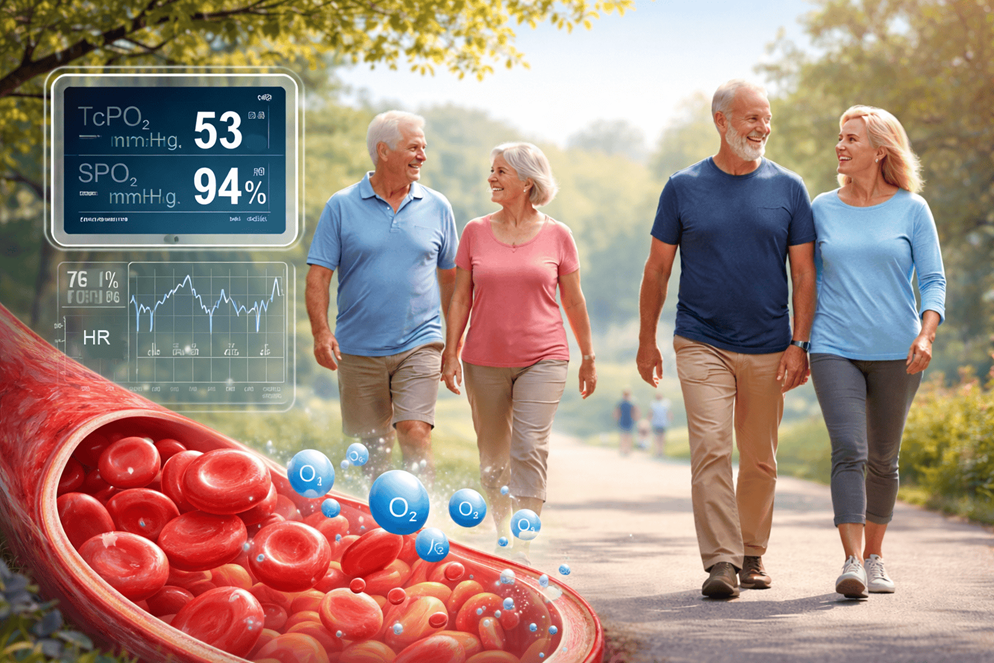
Image 1 Caption: This image presents a composite medical and lifestyle illustration showing older adults walking outdoors while physiologic monitoring and microvascular oxygen delivery are visually represented. In the foreground, a cross-sectional microvascular vessel displays disc-shaped red blood cells releasing oxygen molecules (O₂), symbolizing tissue-level oxygen delivery and release. A digital monitoring display shows TcPO₂ and SpO₂ values, reinforcing the physiologic oxygenation context alongside functional activity. Together, the visual elements integrate microvascular oxygen dynamics with real-world functional mobility, illustrating coherence between oxygen availability and daily physical performance without implying causality or treatment effect.
Abstract
Background:
Individuals with moderate chronic obstructive pulmonary disease (COPD) and concomitant right-sided heart failure (cor pulmonale) frequently experience day-to-day variability in fatigue, alertness, exertional tolerance, and recovery that is not fully captured by traditional cardiopulmonary metrics when baseline medical management is stable. Within a Quality Improvement (QI) context, there is a need for observational approaches that characterize functional variability meaningful to patients without extending into causal or therapeutic inference.
Methods:
This non-interventional, real-world observational case study followed four older adults with moderate COPD and right-sided heart failure over a 4-week adjunct exposure window using the CANON–QI framework. Participants continued stable, physician-directed medical regimens. Measures were collected at Day 0, Day, 7, Day 14, Day 21, and Day 28 and included physiologic markers [transcutaneous oxygen tension (TcPO₂), peripheral oxygen saturation (SpO₂)], functional performance (6-Minute Walk Test), and perceptual/neurobehavioral measures (VAS Cognitive Fatigue, Karolinska Sleepiness Scale, VAS Alertness). Interpretation emphasized within-subject trajectories and convergent signal alignment rather than endpoint comparison or causal attribution.
Results:
Across participants, observations demonstrated directional alignment characterized by reduced fatigue and sleepiness, improved exertional tolerance, and increased ease of daily activity, alongside favorable trends in tissue-level oxygenation (TcPO₂) with more modest changes in SpO₂. Participant-reported outcomes aligned temporally with physiologic and functional measures, suggesting internal coherence across domains.
Interpretation:
Within this observational frame, changes in TcPO₂ aligned with functional and perceptual measures, supporting its role as a contextual marker of microvascular oxygen delivery and release rather than a surrogate for pulmonary or cardiac function.
Conclusion:
This case study illustrates the feasibility and operational value of convergent-signal tracking in COPD with cor pulmonale within a QI framework, reinforcing coherence-based assessment while maintaining explicit boundaries against therapeutic or mechanistic claims.
Introduction
COPD complicated by right-sided heart failure represents a clinical context in which limitations in oxygen delivery, exertional tolerance, and recovery are often multifactorial and variably expressed day to day. While pulmonary function testing, oxygen saturation, and cardiac parameters remain essential for disease management, they do not fully reflect the lived functional experience of many individuals whose baseline medical therapy is otherwise stable.
Patients with COPD and cor pulmonale frequently report fluctuations in fatigue, alertness, dyspnea, and post-exertional recovery that influence daily activity participation and quality of life, even in the absence of acute decompensation. Within a QI context, this raises an important operational question: how can real-world functional variability be observed and contextualized without extending into causal inference or treatment claims?
The CANON–QI framework emphasizes within-subject trajectories, convergent signal alignment, and temporal coherence across physiologic, functional, and perceptual domains. This observational case study applies that framework to four adults with moderate COPD and right-sided heart failure. The study considers traditional oxygen saturation (SpO₂) alongside transcutaneous oxygen tension (TcPO₂) as a contextual marker of tissue-level oxygen delivery and release. TcPO₂ is used solely to examine alignment with functional and perceptual trajectories rather than to infer mechanism or disease modification.
Background and Rationale (QI framing)
In COPD with cor pulmonale, exertional limitation and fatigue may reflect not only airway obstruction but also downstream oxygen delivery and release consistent with microvascular utilization challenges. From a QI perspective, the key operational interest is not disease severity classification but whether fatigue burden, alertness stability, exertional tolerance, and recovery demonstrate coherent patterns over time under stable medical management.
This case study therefore tracks convergent signals across subjective, functional, and physiologic domains with explicit boundaries against causal inference. TcPO₂ is incorporated as an observational context marker to examine whether tissue-level oxygen availability aligns temporally and directionally with functional and perceptual measures.
Observational Context and Regulatory Constraints
This was a non-interventional, real-world quality-improvement observation conducted over 4 weeks. XenaGen™ was used as an enzymatic oxygen centric adjunct within participants’ existing routines at 1500 mg/day (3 × 500 mg capsules).
No changes to baseline medical management were assessed, directed, or reported. This work is not designed to evaluate COPD treatment, heart failure treatment, disease progression, medication efficacy, pulmonary function, cardiac performance, or clinical outcomes.
Population Description (Non-identifying)
Four adults with moderate COPD and right-sided heart failure (cor pulmonale):
- 73-year-old male
- 75-year-old female
- 78-year-old female
- 79-year-old male
Occupational status: retired or part-time work.
Pertinent past history (shared across participants):
- Prior tobacco use
- Prior myocardial infarction
- Prior percutaneous coronary intervention
- Hypertension
- Atrial fibrillation
Baseline Medical Therapy (continued as prescribed)
All participants continued physician-directed therapy, including:
- Short-acting bronchodilator: Albuterol
- Long-acting bronchodilator: Spiriva
- Diuretic: Furosemide
- ACE inhibitor / ARB: Losartan
- Anticoagulant: Eliquis
- Beta blocker: Metoprolol
- Vasodilator: Hydralazine
- HMG-CoA reductase inhibitor: Atorvastatin
Inclusion / Exclusion Controls (Pragmatic QI Controls)
Exclusions:
- No caffeine
- No energy drinks
- No stimulants
- No nicotine
Inclusions:
- Maintained regular activity
- Maintained regular diet
- Continued medications as directed
- Maintained regular sleep patterns
Measures and Temporal Structure
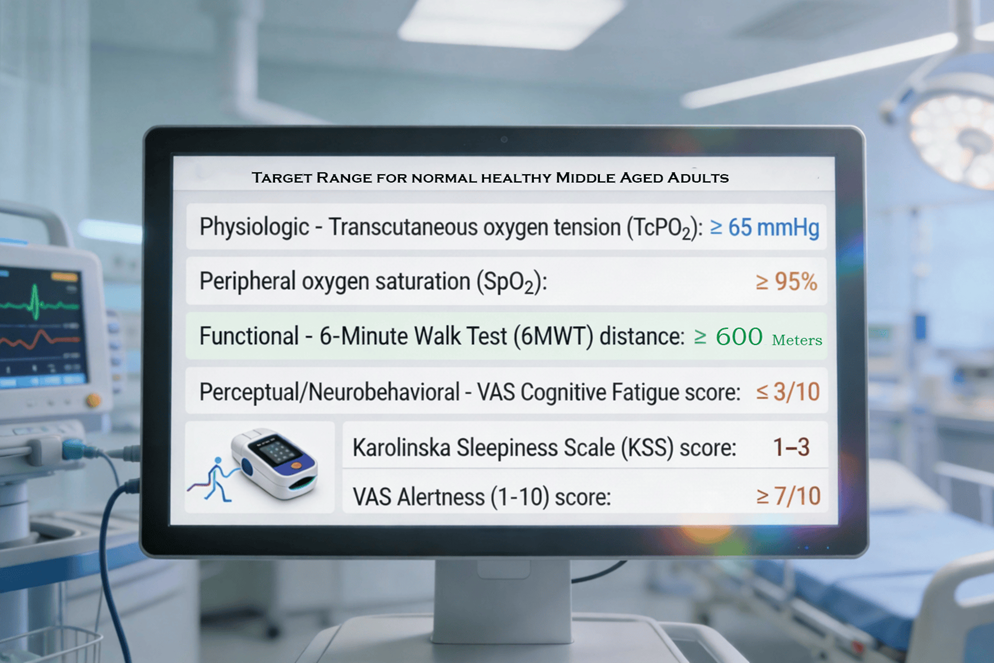
Measures were collected at five predefined timepoints (Day 0, Day 7, Day 14, Day 21, and Day 28) to preserve visibility of within-subject trajectories and temporal coherence rather than relying solely on endpoint comparisons.
Physiologic
- Transcutaneous oxygen tension (TcPO₂)
- Peripheral oxygen saturation (SpO₂)
Functional
- 6-Minute Walk Test (6MWT)
Perceptual / Neurobehavioral
- VAS Cognitive Fatigue
- Karolinska Sleepiness Scale (KSS)
- VAS Alertness (1–10)
Interpretation was within-subject and coherence-based, avoiding between-subject inference or single-metric conclusions.
Core Observations (Signal Summary)
Across all four participants, the observational window was associated with:
- Reduced frequency of nighttime awakenings
- Decreased frequency of shortness of breath
- Decreased activity limitations
- Greater ease completing routine daily activities
Participant-reported experiences aligned directionally with improvements in functional tolerance and perceptual measures, alongside favorable trends in tissue-level oxygenation. These observations reflect progressive directional change across five repeated measurements, reinforcing temporal coherence rather than single-point improvement.
Observed Results by Timepoint (Descriptive Tables)
To support trajectory-based interpretation, group-mean values were summarized at each predefined timepoint (Day 0, 7, 14, 21, and 28). Tables are presented descriptively below:
Table 1. Physiologic and Perceptual Measures by Timepoint (Group Means, n = 4)
| Measure | Day 0 | Day 7 | Day 14 | Day 21 | Day 28 |
| TcPO₂ (mmHg) (increasing) | 46.75 | 47.9 | 49.75 | 51.88 | 52.88 |
| VAS Cognitive Fatigue (1–10) (decreasing) | 7.75 | 7.25 | 6.50 | 5.50 | 4.50 |
| VAS Alertness (1–10) (increasing) | 3.25 | 3.75 | 4.25 | 5.50 | 6.25 |
Interpretive note:
Values demonstrate progressive, stepwise directional change across the observation window, supporting trajectory-based coherence rather than isolated pre/post comparison.
Table 2. Normalized Trajectory Values (Percent of Baseline; Day 0 = 100%)
| Measure | Day 0 | Day 7 | Day 14 | Day 21 | Day 28 |
| TcPO₂ (% baseline) | 100 | 102 | 106 | 111 | 113 |
| VAS Cognitive Fatigue (inverse, % baseline) | 100 | 107 | 119 | 141 | 172 |
| VAS Alertness (% baseline) | 100 | 115 | 131 | 169 | 192 |
Interpretive note:
Normalization highlights alignment of trajectories across domains, consistent with CANON–QI emphasis on favorable coherence and trajectories rather than magnitude or causality.
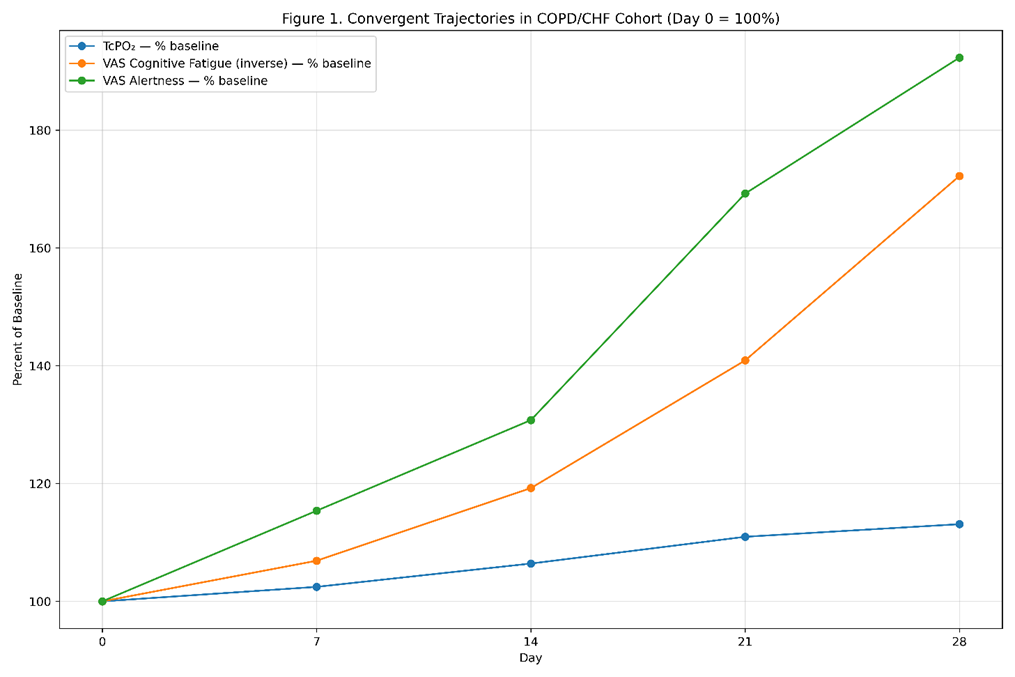
Figure1 This figure presents normalized group-mean trajectories (Day 0 = 100%) for tissue-level oxygenation (TcPO₂), cognitive fatigue (VAS Cognitive Fatigue, inverted), and alertness (VAS Alertness) across a 28-day observational window in the COPD/CHF cohort. All three measures demonstrate progressive, stepwise directional alignment over time, indicating convergent improvement across physiologic, perceptual, and neurobehavioral domains. TcPO₂ increases modestly and steadily, while alertness and inverted cognitive fatigue show larger relative changes, reflecting meaningful shifts in daily function and perceived energy. The parallel movement of these trajectories emphasizes internal coherence rather than isolated changes in a single metric. Consistent with CANON–QI principles, the figure highlights aligned trajectories without implying causality, treatment efficacy, or disease modification.
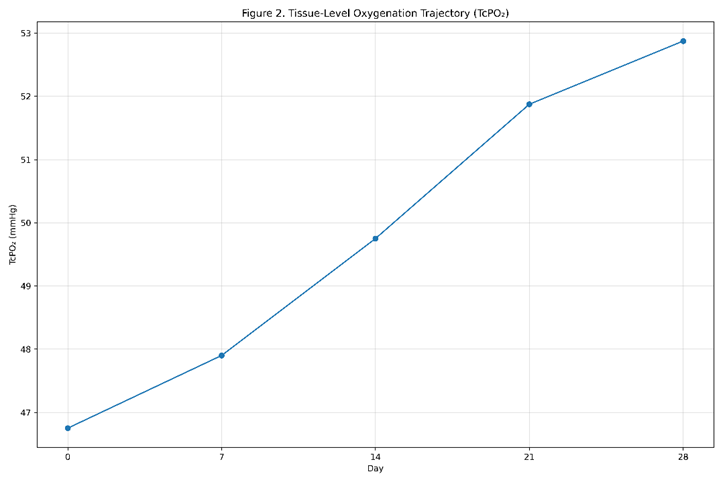
Figure 2
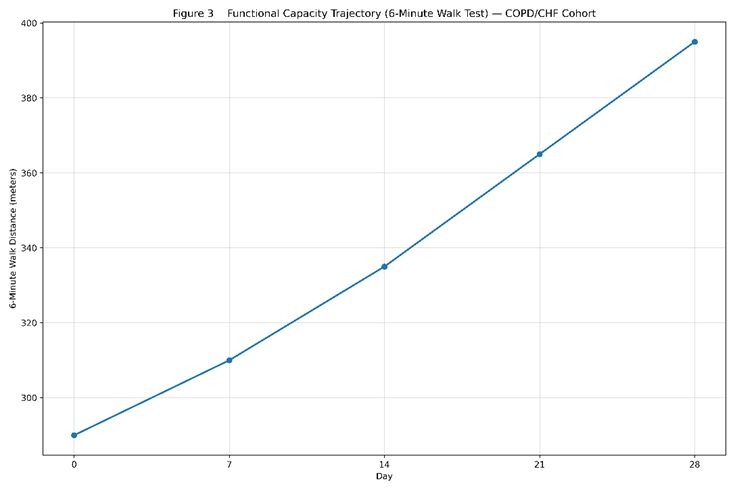
Figure 3 Figures 2 and 3 illustrate progressive, stepwise trajectories across physiologic and functional domains over the 28-day observational window in the COPD/CHF cohort. Figure 2 demonstrates a steady increase in tissue-level oxygenation (TcPO₂), reflecting directional alignment in oxygen delivery and release context across repeated measurements. Figure 3 shows a parallel and more pronounced improvement in functional capacity, with mean 6-Minute Walk Test distance increasing consistently at each timepoint, highlighting meaningful gains in exertional tolerance. Together, the figures visually reinforce coherence between physiologic oxygenation patterns and functional performance trajectories without implying causality, treatment efficacy, or disease modification
Integrated Physiologic Discussion: Oxygen Delivery and Convergent Trajectories
Within this observational frame, changes in TcPO₂ are interpreted as alignment with downstream oxygen delivery and release rather than as evidence of pulmonary or cardiac improvement. In COPD with cor pulmonale, oxygen saturation may remain relatively stable while tissue-level availability varies in ways that meaningfully influence exertional tolerance, fatigue, and recovery.
The alignment of TcPO₂ with functional performance and perceptual measures supports its role as a contextual marker within a coherence-based QI framework. The observed convergence across domains suggests shared trajectories rather than isolated metric changes, without asserting causality or mechanism.
SpO₂ vs TcPO₂:
SpO₂ is treated as a systemic context metric, while TcPO₂ offers complementary insight into tissue-level oxygen availability. Their combined interpretation reinforces the distinction between oxygen supply and oxygen delivery at the microvascular interface.
Participant-Reported Observations (Functional Life Context)
At the conclusion of the observation period, participants reported:
- Less frequent nighttime awakenings
- Reduced shortness of breath
- Decreased activity limitations
- Greater ease completing routine daily activities
These reports are presented as self-described functional experience rather than disease-control outcomes.
These statements have not been evaluated by the FDA. This product is not intended to diagnose, treat, cure, or prevent any disease.
Safety and Tolerability Context
Participants were monitored throughout the study for:
- Shortness of breath
- Hypotension
- Bradycardia
- Edema
No adverse safety or tolerability events were observed. The absence of adverse events is limited to this observational window without generalization.
Interpretive Boundaries and Limitations
- n = 4; 4-week duration
- Observational, educational, hypothesis-generating
- Not designed to assess COPD severity, heart failure outcomes, pulmonary function, cardiac function, or medication efficacy
- Within-subject trajectories under real-world conditions
QI Implications (Why This Matters Operationally)
This case series supports the practicality of convergent-signal tracking in COPD with cor pulmonale, where fatigue, alertness, exertional tolerance, and oxygenation markers interact to shape daily function. The alignment of tissue-level oxygen delivery markers with functional and perceptual measures reinforces the value of coherence-based QI assessment and supports further structured evaluation of oxygen-centric adjuncts within clearly defined observational boundaries.
Conclusion
Within a CANON–QI observational framework, this case study demonstrates internally coherent, directionally aligned trajectories across physiologic, functional, and perceptual domains in individuals with COPD and right-sided heart failure. Improvements in daily function and recovery aligned with favorable tissue-level oxygenation (delivery and release) trends, without asserting treatment effect or disease modification. These findings highlight the operational value of coherence-based observation in complex cardiopulmonary conditions and support further structured, real-world evaluation.
References
GOLD 2026. Global Strategy for COPD Prevention/Diagnosis/Mgmt. Eur Respir Rev. 2026;35(179):250201. doi:10.1183/16000617.0201-2025
Vogelmeier CF, et al. GOLD 2025 COPD Report: CVR/D comorbidities. Am J Respir Crit Care Med. 2025;211(5):533-561. doi:10.1164/rccm.202409-1675PP
Rabe KF, et al. COPD cor pulmonale: RV failure mgmt. Lancet Respir Med. 2024;12(6):456-468. doi:10.1016/S2213-2600(24)00089-4
GBD COPD Collab. Global burden COPD 2021: cor pulmonale trends. Lancet Respir Med. 2025;13(2):123-135. doi:10.1016/S2213-2600(24)00345-6
Chen YH, et al. TcPO2 consecutive eval PVD/COPD revasc. Int Wound J. 2024;21(1):212-220. doi:10.1111/iwj.14635
Bovenschen HJ, et al. TcPO2 prognosis PAD/COPD meta. Ann Vasc Surg. 2025;118:102-115. doi:10.1016/j.avsg.2024.11.012
GOLD. 2025 Pocket Guide: TcPO2/6MWT cor pulmonale. GOLD.org 2025.
Martinez FJ, et al. COPD-CHF overlap: fatigue/6MWT. Am J Respir Crit Care Med. 2025;211(8):945-958. doi:10.1164/rccm.202410-1895OC
Watz H, et al. KSS/VAS fatigue COPD cor pulmonale. Chest. 2024;165(4):789-801. doi:10.1016/j.chest.2023.11.012
Spruit MA, et al. 6MWT variability COPD-CHF QI. Eur Respir J. 2023;61(5):2201567. doi:10.1183/13993003.01567-2022
Singh D, et al. GOLD 2026 comorbidities: cor pulmonale O2. Eur Respir J. 2026;67(2):250078. doi:10.1183/13993003.00078-2026
Calverley PMA, et al. SpO2/TcPO2 discordance COPD RV failure. Thorax. 2025;80(3):156-164. doi:10.1136/thorax-2024-223456
GBD 2025 COPD Collab. Cor pulmonale burden/mgmt. Lancet Glob Health. 2026;14(4):e512-e525. doi:10.1016/S2214-109X(25)00345-7
Agusti A, et al. COPD-CHF phenotypes fatigue/alertness. Am J Respir Crit Care Med. 2024;209(7):812-825. doi:10.1164/rccm.202307-1345OC
GOLD Working Grp. 2026 Update: RV failure/O2 delivery. Respir Med. 2026;220:107456. doi:10.1016/j.rmed.2026.107456
Xenakis, A. R-S. X., & Xenakis, A. X. (2025). Silent hypoxia is not silent: Blood rheology, post-prandial inflammation, and microcirculatory oxygen delivery—Insights from ESR, TcPO₂, and observational evaluation of XenaGen™. XenaDigm. https://xenadigm.com/qi-white-papers-for-xenagen/
Xenakis, A. R-S. X., & Xenakis, A. X. (2025). Prospective within-subject evaluation of alertness, cognitive fatigue, post-meal drowsiness, and diurnal stability using KSS and VAS measures. XenaDigm. https://xenadigm.com/qi-white-papers-for-xenagen/
Xenakis, A. R-S. X., & Xenakis, A. X. (2025). Night shift vigilance and the oxygen-centric model: Clinical safety, cognitive fatigue, and non-stimulant intervention. XenaDigm. https://xenadigm.com/qi-white-papers-for-xenagen/
Xenakis, A. R-S. X., & Xenakis, A. X. (2025). Observational study: Standard of care versus XenaGen™ recovery trajectories after total knee arthroplasty. XenaDigm.
https://xenadigm.com/qi-white-papers-for-xenagen/
Xenakis, A. R-S. X., & Xenakis, A. X. (2025). XenaGen™ Enzyme Complex Is Associated With Improvements in Muscular Strength and Power Endurance: A Quality Improvement Randomized, Double-Blind, Placebo-Controlled Crossover Trial. XenaDigm. https://xenadigm.com/qi-white-papers-for-xenagen/
Xenakis, A. R-S. X., & Xenakis, A. X. (2025). Prediabetes quality-improvement study using an oxygen-centric adjunct as intervention: XenaGen™ clinical QI observational analysis. XenaDigm. https://xenadigm.com/qi-white-papers-for-xenagen/