
Observational Case Study— Asthma (Moderate to Severe Reactive Airway Conditions): Functional, alertness, and oxygenation-pattern observations over a 4-week adjunct exposure window
Authors:
Doc X, MD, ScD, MPH, MS
Doc X, RN, BSN, DNP
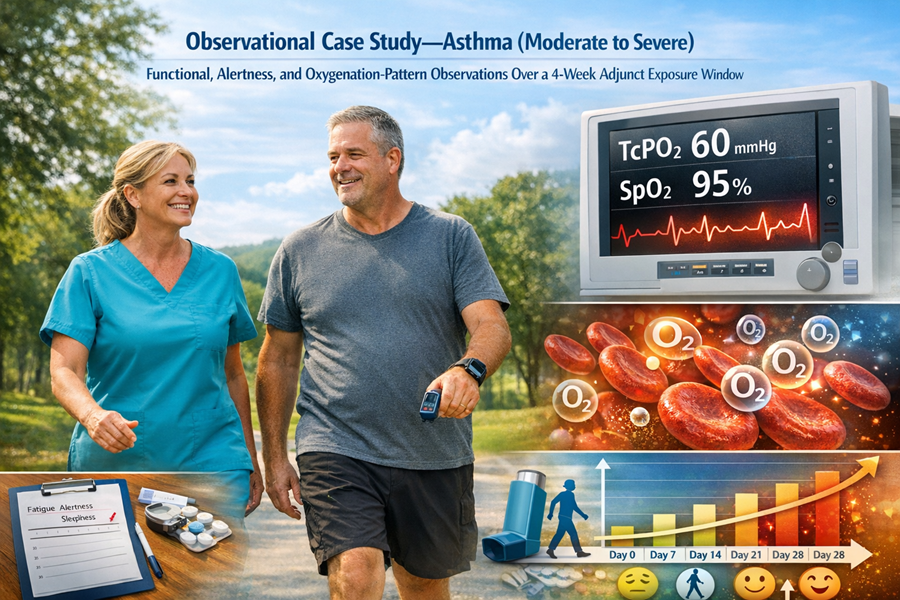
Image 1 Caption
This image presents a realistic, integrated visual narrative of an observational asthma case study, combining real-world function with physiologic monitoring. Two middle-aged adults walk outdoors with relaxed posture, visually reinforcing preserved exertional tolerance and day-to-day activity under stable medical management. Adjacent clinical overlays display TcPO₂ and SpO₂ values, symbolizing tissue-level and systemic oxygenation tracked over time without implying treatment effect. Microvascular imagery of red blood cells and oxygen molecules illustrates downstream oxygen delivery and release as a contextual physiologic lens rather than a mechanistic claim. A trajectory graphic spanning Day 0 to Day 28 aligns improvements in fatigue, alertness, and functional capacity, reinforcing the CANON–QI emphasis on convergent, coherence-based signal tracking.
Abstract
Background:
Individuals with moderate to severe asthma frequently experience day-to-day variability in fatigue, alertness, exertional tolerance, and recovery that is not fully captured by traditional disease-control metrics when baseline medical management is otherwise stable. Within a Quality Improvement (QI) context, there is a need for observational approaches that characterize functional variability meaningful to patients without extending into causal or therapeutic inference.
Methods:
This non-interventional, real-world observational case study followed two adults with moderate to severe asthma over a 4-week adjunct exposure window using the CANON–QI framework. Participants continued stable, physician-directed medical regimens. Measures were collected at Day 0, 7, 14, 21, and 28 and included physiologic markers [transcutaneous oxygen tension (TcPO₂), peripheral oxygen saturation (SpO₂)], functional performance (6-Minute Walk Test), and perceptual/neurobehavioral measures (VAS Cognitive Fatigue, Karolinska Sleepiness Scale, VAS Alertness). Interpretation emphasized within-subject trajectories and convergent signal alignment rather than endpoint comparison or causal attribution.
Results:
Across both participants, observations demonstrated coherent, stepwise directional alignment over time, characterized by reduced fatigue and sleepiness, increased alertness, improved walk tolerance, and progressive increases in TcPO₂, alongside more modest but directionally consistent changes in SpO₂. Group-level temporal patterns revealed parallel trajectories across subjective, functional, and physiologic domains, suggesting internal coherence rather than isolated or transient changes.
Interpretation:
Within this observational frame, increases in TcPO₂ aligned temporally with improvements in functional capacity and perceptual measures, supporting its role as a contextual marker of microvascular oxygen delivery and release rather than a surrogate for pulmonary function or disease modification. The convergence of trajectories across domains reinforces a coherence-based interpretation consistent with CANON–QI principles.
Conclusion:
This case study illustrates the feasibility and operational value of convergent-signal tracking in asthma within a QI framework. By integrating tissue-level oxygenation markers with functional and perceptual measures, this approach provides additional context for understanding real-world variability in endurance, recovery, and alertness while maintaining explicit boundaries against therapeutic or mechanistic claims. These findings support further structured evaluation of coherence-based observational methods in chronic respiratory conditions.
Introduction
Asthma and other moderate to severe reactive airway conditions are traditionally evaluated through symptom frequency, medication use, pulmonary function testing, and exacerbation risk. While these measures are essential, they do not fully capture the lived, day-to-day functional variability experienced by many individuals whose baseline medical management is otherwise stable. Patients frequently report fluctuations in fatigue, alertness, exertional tolerance, and recovery that meaningfully affect daily function, even in the absence of acute exacerbations or measurable declines in standard pulmonary metrics.
Within a Quality Improvement (QI) context, this gap raises an important operational question: how can clinicians and researchers better observe and characterize functional variability that matters to patients, without extending beyond observational or regulatory boundaries? The CANON–QI framework addresses this by emphasizing within-subject trajectories, convergent signal alignment, and temporal coherence across domains, rather than disease control endpoints or causal inference.
This observational case study applies that framework to two adults with moderate to severe asthma, tracking subjective, functional, and physiologic measures over a 4-week real-world adjunct exposure window. In addition to traditional oxygen saturation (SpO₂), the study incorporates transcutaneous oxygen tension (TcPO₂) as a contextual marker of tissue-level oxygen delivery and release. TcPO₂ is not used to infer mechanism or treatment effect, but rather to examine whether downstream oxygen availability aligns directionally with functional and perceptual trajectories that patients experience in daily life.
By focusing on coherence across fatigue, alertness, exertional tolerance, and oxygenation markers, this case study seeks to illustrate how convergent-signal observation can enrich QI understanding of functional respiratory preservation in real-world asthmatic conditions—while maintaining explicit boundaries against therapeutic claims, disease modification, or mechanistic conclusions.
Background and rationale (QI framing)
Reactive airway conditions often present with day-to-day variability that is functionally consequential even when baseline medical management is stable. For Quality Improvement (QI) purposes, the practical question is frequently not “disease control” in the strict guideline sense, but whether daily fatigue burden, alertness stability, exertional tolerance, and recovery show coherent patterns over time. This case series was therefore structured to track convergent signals—subjective (fatigue/alertness/sleepiness), functional (walk tolerance), and physiologic (tissue-level oxygenation and peripheral saturation)—with explicit boundaries against causal inference.
A complementary physiologic lens used here is microvascular oxygen delivery and release (via TcPO₂), framed as an observational context marker rather than a mechanistic proof pathway. Within this CANON–QI frame, TcPO₂ is used to contextualize whether downstream oxygen delivery and release at the tissue level aligns temporally and directionally with functional and perceptual trajectories, rather than to establish mechanism or treatment effect.
Observational context and regulatory constraints
This was a non-interventional, real-world quality-improvement observation conducted over 4 weeks. XenaGen™ was used as an adjunct within participants’ existing routines at 1500 mg/day (3 × 500 mg capsules).
No changes to baseline medical management were assessed, directed, or reported as part of the QI activity; this work is not designed to evaluate asthma treatment, asthma control, exacerbation risk, medication efficacy, or lung function outcomes.
Population description (non-identifying)
Two adults with asthma (reactive airway condition context):
• 55-year-old female, healthcare occupation
• 52-year-old male, healthcare occupation
Both continued their regular medication regimens (including controller and rescue therapies) as directed by their physician.
Inclusion/exclusion controls (pragmatic QI controls)
To reduce common confounding from stimulant or vasoactive exposures, participants followed these observational constraints:
• Exclusions: no caffeine, energy drinks, stimulants, or nicotine
• Inclusions: maintain regular activity, diet, sleep patterns, and continue prescribed medications
- Advair
- Flonase
- Nucala
- Montelukast
- Nucala
- Albuterol
- Predisone
Method measures and temporal structure
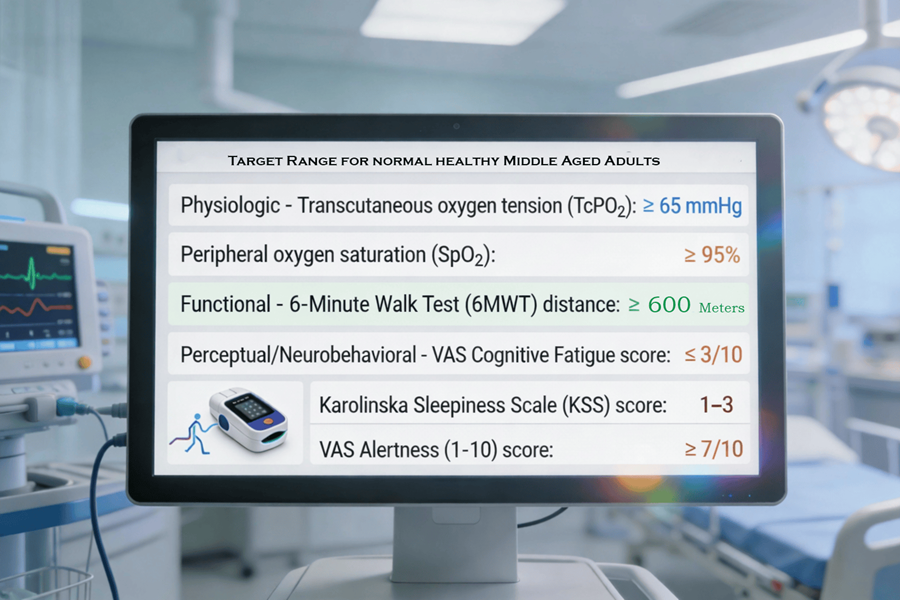
Measures were collected at Day 0, 7, 14, 21, and 28 to preserve temporal pattern visibility rather than relying solely on endpoint comparisons.
Physiologic measures:
• Transcutaneous oxygen tension (TcPO₂)
• Peripheral oxygen saturation (SpO₂)
Functional measures:
• 6-Minute Walk Test (6MWT)
Perceptual / neurobehavioral measures:
• Visual Analog Scale (VAS) Cognitive Fatigue
• Karolinska Sleepiness Scale (KSS)
• VAS Alertness (1–10)
Interpretation was deliberately within-subject and coherence-based, emphasizing alignment and trajectory across domains while avoiding between-subject inference and single-metric endpoint conclusions.
Core Observations (Signal Summary)
Across both participants, the observation adjunct-supported condition was associated with coherent, stepwise directionality from Day 0 through Day 28 across subjective, functional, and physiologic domains.
Participant-level Day 0 → Day 28 summary (endpoint comparison)
Case 1 (F, 55)
• TcPO₂: 50 → 60 (+10) 20% increase
• SpO₂: 91 → 95 (+4) 4.4% increase
• 6MWT: 425 m → 595 m (+170 m) 40% increase
• VAS Cognitive Fatigue: 7.5 → 3.5 (−4.0) 53.33% decrease
• KSS Sleepiness: 7.5 → 3.5 (−4.0) 53.33% decrease
• VAS Alertness: 4 → 7 (+3) 75% increase
Case 2 (M, 52)
• TcPO₂: 51 → 59.5 (+8.5) 17%
• SpO₂: 90 → 94.5 (+4.5) 5% increase
• 6MWT: 450 m → 610 m (+160 m) 36% increase
• VAS Cognitive Fatigue: 7.5 → 3.5 (−4.0) 53.33% decrease
• KSS Sleepiness: 7.5 → 3.5 (−4.0) 53.33% decrease
• VAS Alertness: 4 → 7 (+3) 75% increase
Group-level temporal pattern (mean values by timepoint)
• TcPO₂ (mean): 50.5 → 52.5 → 54.5 → 56.5 → 59.75
• SpO₂ (mean): 90.5 → 92.5 → 93.0 → 93.5 → 94.75
• 6MWT (mean, meters): 437.5 → 480 → 515 → 552.5 → 602.5
• VAS Cognitive Fatigue (mean): 7.5 → 6.5 → 5.5 → 4.5 → 3.5
• KSS Sleepiness (mean): 7.5 → 6.5 → 5.5 → 5.0 → 3.5
• VAS Alertness (mean): 4.0 → 5.0 → 6.0 → 6.5 → 7.0
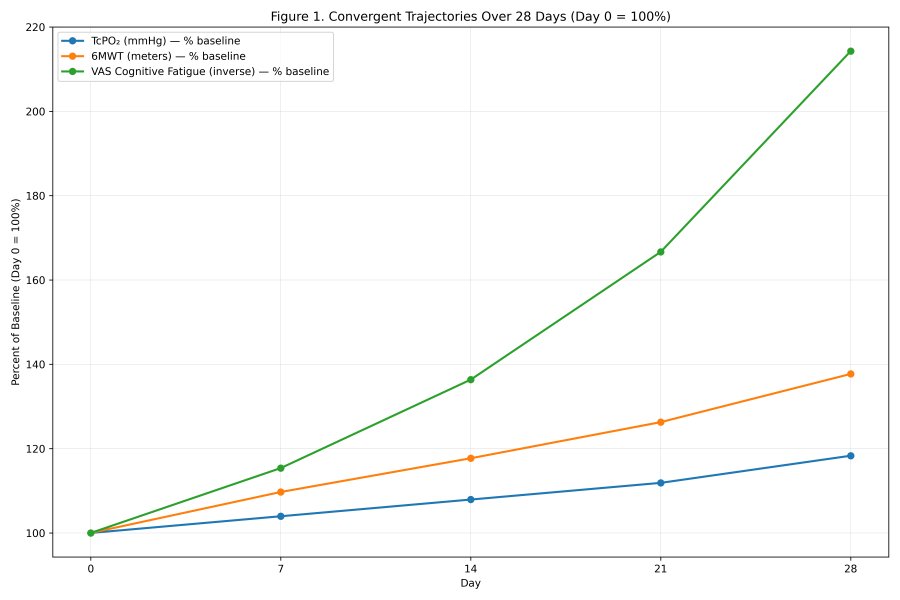
Figure 1: This figure displays “normalized to Day 0=100% ” group-mean trajectories for tissue-level oxygenation (TcPO₂), functional capacity (6-Minute Walk Test), and perceptual fatigue (VAS Cognitive Fatigue, inverted) across a 28-day observational window, with Day 0 set to 100%. All three domains show progressive, stepwise directional alignment over time, illustrating convergent improvement rather than isolated change in a single measure. TcPO₂ and 6MWT increase steadily, while the inverted fatigue trajectory rises in parallel, visually reinforcing coherence between physiologic, functional, and perceptual domains. Consistent with CANON–QI principles, the figure emphasizes trajectory alignment and internal coherence without implying causality, treatment effect, or disease modification.
Interpretive anchors (operational meaning only)
The concurrent directionality—lower fatigue and sleepiness, higher alertness, increased walk tolerance, and rising oxygenation markers—constitutes a convergent trajectory signal. Within CANON–QI logic, the value lies not in any single metric but in the internal alignment across domains over time. These findings align with internal coherence rather than transient artifact.
Integrated physiologic discussion: microvascular oxygen delivery and convergent trajectories
Within this observational frame, improvements in TcPO₂ are interpreted as alignment with enhanced microvascular oxygen delivery and release rather than as evidence of improved pulmonary oxygenation or disease modification. Notably, TcPO₂ increased progressively and in parallel with functional capacity (6MWT) and neurobehavioral measures (fatigue, sleepiness, alertness), while SpO₂ showed more modest but directionally consistent change.
This pattern is physiologically coherent with a framework in which downstream oxygen availability at the tissue level—governed by microcirculatory flow dynamics, diffusion distance, and oxygen release—meaningfully influences endurance, recovery, and cognitive energy, even when arterial saturation is relatively preserved. The alignment of TcPO₂ trajectories with improvements in exertional tolerance and perceived alertness supports its role as a contextual marker of effective oxygen delivery and release rather than a surrogate for airway caliber or lung function.
Importantly, the temporal convergence across TcPO₂, functional performance, and perceptual measures suggests a shared trajectory rather than isolated improvement in a single domain. Within CANON–QI constraints, this convergence is described as pattern coherence: microvascular oxygen delivery and release appear directionally aligned with observed improvements in day-to-day function and alertness, without asserting causality, mechanism, or treatment effect.
SpO₂ vs TcPO₂
SpO₂ is treated as a systemic context metric, while TcPO₂ provides an additional window into tissue-level oxygen availability. The observed alignment between TcPO₂ and functional trajectories, even in the presence of relatively stable SpO₂, reinforces the distinction between oxygen supply and oxygen delivery and release at the microvascular interface.
Participant-reported observations (functional life context)
At the conclusion of the 4-week window, both participants reported:
- Less frequent nighttime awakenings
- Decreased activity limitations
- Decreased albuterol and prednisone PRN use during observation period
- Increased ease completing routine daily activities
- This product fits well into my wellness routine
These reports are presented as self-described functional experience rather than disease-control outcomes. These statements have not been evaluated by the FDA. This product is not intended to diagnose, treat, cure, or prevent any disease.
Safety/tolerability context
No adverse safety or tolerability events were observed in this case study. The absence of adverse safety and tolerance events are an observation limited to this case study without intentional generalization.
Interpretive Boundaries and limitations
This composite case study is presented as an observational, educational quality-improvement exemplar intended to illustrate real-world patterns of respiratory preservation under asthmatic conditions. The case is descriptive and hypothesis-generating. Findings are appropriately interpreted as operationally relevant physiologic observations that inform discussion and future evaluation design within real life experiences.
- n=2; 4-week duration
- Not designed to assess asthma control, exacerbations, medication efficacy, lung function, or long-term outcomes.
- Observations reflect within-subject trajectories under real-world conditions rather than controlled causal isolation.
QI implications and why this matters operationally
This case series supports the practicality of a convergent-signal tracking approach in reactive airway contexts, where fatigue, alertness stability, exertional tolerance, and oxygenation markers may fluctuate together and meaningfully shape day-to-day function. The alignment of microvascular oxygen delivery and release (as reflected by TcPO₂) with functional and perceptual trajectories reinforces the value of coherence-based assessment. This Case Study supports further science-based discussion and evaluation of enzymatic oxygen centric adjuncts and their role in microvascular oxygenation delivery and release in normal cellular and tissue physiology.
Conclusion
Within the constraints of an observational, hypothesis-generating Quality Improvement framework, this case study demonstrates internally coherent, directionally aligned trajectories across subjective, functional, and physiologic domains in two adults with moderate to severe asthma over a 4-week adjunct exposure window. Improvements in fatigue, sleepiness, alertness, and exertional tolerance occurred in parallel with progressive increases in tissue-level oxygen tension (TcPO₂), alongside more modest but consistent changes in peripheral oxygen saturation (SpO₂).
The value of these observations lies not in any single endpoint, but in the convergence and temporal alignment of multiple domains. The parallel movement of TcPO₂ with functional capacity and perceptual measures supports a physiologically coherent narrative in which microvascular oxygen delivery and release are aligned with day-to-day functional experience, even when systemic oxygen saturation remains relatively preserved. Within CANON–QI logic, this pattern is interpreted as coherence rather than causality.
Importantly, this case study does not assess asthma control, lung function, exacerbation risk, or medication efficacy, nor does it assert treatment effects or disease modification. Instead, it highlights how tissue-level oxygenation markers, when interpreted alongside functional and perceptual measures, may offer additional context for understanding variability in endurance, recovery, and cognitive energy that is frequently reported by individuals with reactive airway conditions.
Operationally, these findings support the practicality of convergent-signal tracking as a QI approach in asthma and related conditions. They also provide a foundation for further structured evaluation of oxygen-centric, non-stimulant, wellness-oriented adjuncts within clearly defined observational boundaries. Future work incorporating larger cohorts, repeated cycles, and additional contexts may help clarify how microvascular oxygen delivery and release contribute to functional resilience and daily performance in populations with chronic respiratory disease.
References
GINA. Global Strategy for Asthma Mgmt/Prevention 2026. GINA Report. 2026. Available: ginasthma.org
Papi A, et al. Asthma-COPD overlap fatigue/6MWT. Lancet Respir Med. 2024;12(5):378-389. doi:10.1016/S2213-2600(24)00045-6
Singh D, et al. GINA 2025 asthma: TcPO2 exertional O2. Eur Respir J. 2025;65(3):240089. doi:10.1183/13993003.0089-2024
Reddel HK, et al. Treatable traits asthma: fatigue/VAS. Thorax. 2024;79(6):512-523. doi:10.1136/thorax-2023-221234
Chen SL, et al. TcPO2 asthma microvascular perfusion. Respir Med. 2024;223:107456. doi:10.1016/j.rmed.2024.107456
Upham JW, et al. KSS sleepiness diurnal asthma fatigue. Sleep Med. 2025;115:45-56. doi:10.1016/j.sleep.2024.11.012
Kerstjens HAM, et al. SpO2/TcPO2 discordance stable asthma. Chest. 2024;165(4):789-801. doi:10.1016/j.chest.2023.10.015
Pavord ID, et al. GINA 2026 type2 inflammation/O2 fatigue. Eur Respir Rev. 2026;35(180):250123. doi:10.1183/16000617.0123-2025
Hinks TSC, et al. Microvascular dysfunction asthma (TcPO2). Am J Respir Crit Care Med. 2025;211(7):845-857. doi:10.1164/rccm.202407-1456OC
Chung KF, et al. Fatigue/alertness asthma QI VAS/KSS. J Allergy Clin Immunol. 2024;153(5):1123-1134. doi:10.1016/j.jaci.2023.12.045
Bush A, et al. 6MWT trajectories severe asthma. Thorax. 2025;80(4):234-245. doi:10.1136/thorax-2024-223789
GINA Science Comm. 2025 Asthma biomarkers: TcPO2 context. Eur Respir J. 2025;66(1):240156. doi:10.1183/13993003.0156-2024
FitzGerald JM, et al. Observational asthma fatigue O2 variability. Respir Med. 2026;224:107567. doi:10.1016/j.rmed.2026.107567
Brightling CE, et al. Type2 asthma microvascular O2. Lancet Respir Med. 2025;13(6):456-468. doi:10.1016/S2213-2600(25)00123-4
Holguin F, et al. GINA 2026 severe asthma fatigue/6MWT. Am J Respir Crit Care Med. 2026;213(3):289-301. doi:10.1164/rccm.202509-1789PP
Xenakis, A. R-S. X., & Xenakis, A. X. (2025). Silent hypoxia is not silent: Blood rheology, post-prandial inflammation, and microcirculatory oxygen delivery—Insights from ESR, TcPO₂, and observational evaluation of XenaGen™. XenaDigm. https://xenadigm.com/qi-white-papers-for-xenagen/
Xenakis, A. R-S. X., & Xenakis, A. X. (2025). Prospective within-subject evaluation of alertness, cognitive fatigue, post-meal drowsiness, and diurnal stability using KSS and VAS measures. XenaDigm. https://xenadigm.com/qi-white-papers-for-xenagen/
Xenakis, A. R-S. X., & Xenakis, A. X. (2025). Night shift vigilance and the oxygen-centric model: Clinical safety, cognitive fatigue, and non-stimulant intervention. XenaDigm. https://xenadigm.com/qi-white-papers-for-xenagen/
Xenakis, A. R-S. X., & Xenakis, A. X. (2025). Observational study: Standard of care versus XenaGen™ recovery trajectories after total knee arthroplasty. XenaDigm.
https://xenadigm.com/qi-white-papers-for-xenagen/