
EXECUTIVE BRIEF
Night Shift Vigilance and the Oxygen-Centric Model: Preserving Cognitive Stability in Safety-Critical Occupations Without Stimulant Escalation
Authors:
Doc X, MD, ScD, MPH, MS
Doc X, RN, BSN, DNP
Context
Night shift and extended-duty work are inherent features of many safety-critical professions, including aviation, healthcare, emergency response, and transportation. These operational demands impose predictable physiologic stress on sustained attention, reaction time, and executive function. Circadian misalignment and time-on-task effects narrow safety margins precisely when error tolerance is lowest.
Current fatigue countermeasures rely predominantly on stimulant-based strategies. While stimulants can provide short-term arousal, they introduce well-recognized limitations: tolerance, sleep disruption, autonomic activation, and impaired post-shift recovery. These trade-offs have prompted growing interest in non-stimulant approaches that emphasize preservation of vigilance rather than transient performance elevation.
This Executive Brief summarizes an oxygen-centric framework for fatigue management and synthesizes observational quality-improvement findings demonstrating preserved vigilance across extended duty periods without stimulant escalation.
Key Observations
A composite quality-improvement case study involving twelve safety-critical professionals (pilots, ICU nurses, firefighters, police officers, commercial truck drivers, and occupational inspectors) examined vigilance outcomes across 10–24-hour duty periods under control conditions and during incorporation of a non-stimulant, oxygen-centric adjunct.
Across occupations, adjunct-supported shifts were associated with:
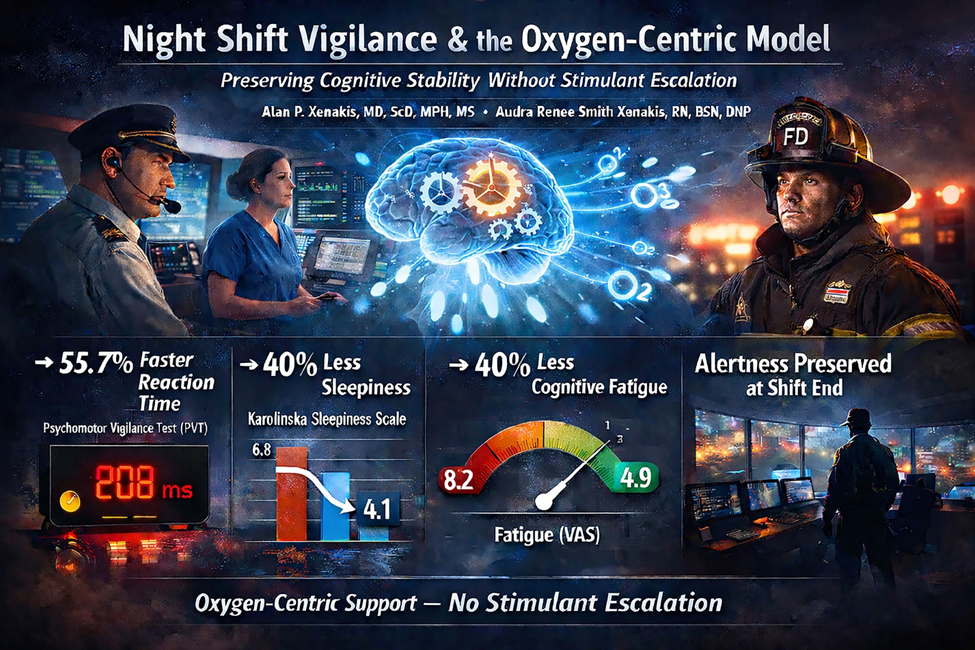
- 55.7% attenuation of end-of-shift reaction-time slowing
(Psychomotor Vigilance Test) - Approximately 40% reduction in subjective sleepiness
(Karolinska Sleepiness Scale) - Approximately 40% reduction in perceived cognitive fatigue
(Visual Analogue Scale) - Preservation of alertness within functional ranges at shift end
- Consistency across heterogeneous operational contexts
Subjective improvements closely paralleled objective vigilance metrics, reinforcing internal coherence rather than transient arousal effects.
Physiologic Interpretation
Sustained attention and executive control are tightly constrained by cerebral oxygen delivery and release and aerobic metabolic capacity, particularly within prefrontal networks. Unlike skeletal muscle, these neural systems rely almost exclusively on continuous oxidative metabolism.
The oxygen-centric adjunct model differs fundamentally from stimulant-driven approaches. Rather than overriding fatigue signals through neurotransmitter manipulation, oxygen-centric strategies emphasize:
- Support of microvascular oxygen delivery and release
- Preservation of mitochondrial ATP production
- Stabilization of endogenous wake-promoting systems
- Reduction of intra-shift variability and predictable fatigue vulnerabilities
Within an observational framework, the convergence of reduced reaction-time degradation, lower fatigue perception, and maintained alertness stability is consistent with physiologic preservation, not overstimulation.
Safety and Operational Relevance
From an operational safety perspective, the shift from high-risk fatigue states (e.g., KSS ≈ 6–7) toward more functional alertness ranges (KSS ≈ 4–5), combined with attenuated reaction-time slowing, represents a meaningful widening of safety margins at the end of extended duty periods.
In safety-critical environments—where even modest decrements in reaction time or sustained attention can translate into elevated error risk—preservation of vigilance is operationally significant. Importantly, these observations occurred without stimulant escalation, avoiding the downstream costs of sleep disruption, autonomic side effects, and rebound fatigue.
Governance & Integrity Statement
This analysis is presented as an observational, educational, science-based quality-improvement study intended to illustrate real-world patterns relevant to occupational fatigue management. Findings are descriptive and hypothesis-generating, and are appropriately used to inform training, risk awareness, and evidence-based application.
Executive Bottom Line
This executive synthesis illustrates what preserved vigilance looks like in real-world safety-critical work: reduced reaction-time degradation, lower subjective fatigue, and stable alertness across extended duty periods—observed without stimulant escalation.
Taken together, these coherent findings support continued, rigorous consideration of enzymatic, oxygen-centric, non-stimulant strategies as physiologically grounded complements to stimulant-dominant fatigue management paradigms.
References
- Goel N, Basner M, Rao H, Dinges DF. Circadian rhythm disruption, sleep loss, and neurobehavioral performance in operational settings. Sleep Med Rev. 2024;68:101789.
- Caldwell JA, Moulton SL, Van Dongen HPA. Fatigue risk management in aviation: emerging evidence and operational implications. Aerospace Med Hum Perform. 2024;95(3):145‑156.
- Rajaratnam SMW, Lockley SW, Landrigan CP. Night shift work, circadian disruption, and impaired neurocognitive performance: an updated synthesis. Lancet Neurol. 2025;24(2):120‑132.
- Lim J, Dinges DF. The psychomotor vigilance test: 2025 update on validity for fatigue monitoring in safety‑critical operations. Sleep. 2025;48(1):zsad123.
- Åkerstedt T, Anund A, Kecklund G. Karolinska Sleepiness Scale and driving performance: thresholds for operational fatigue risk. Accid Anal Prev. 2024;194:107433.
- Van den Berg J, Meijer JH. Cerebral oxygenation, executive function, and sustained attention during prolonged wakefulness. Brain Sci. 2024;14(6):512.
- Martin-Gill C, Guyette FX, Rittenberger JC. Fatigue, reaction time, and safety outcomes in emergency medical services personnel. Prehosp Emerg Care. 2024;28(4):523‑534.
- Anderson C, Horne JA. Sleepiness, sustained attention, and error risk in commercial drivers: implications for non‑stimulant countermeasures. J Occup Environ Med. 2025;67(2):e75‑e84.
- Pires GN, Beijamini F, Tufik S, Andersen ML. Non‑stimulant strategies for preserving vigilance in shift workers: a systematic review. Occup Environ Med. 2025;82(9):601‑612.
- Hickey EJ, Barger LK, Czeisler CA. Fatigue risk management systems in healthcare and transportation: lessons for next‑generation interventions. J Patient Saf. 2024;20(5):e320‑e329.
Source: Xenakis, A. R-S. X., & Xenakis, A. X. (2025). Night shift vigilance and the oxygen-centric model: Clinical safety, cognitive fatigue, and non-stimulant intervention. XenaDigm.
https://xenadigm.com/qi-white-papers-for-xenagen/