
EXECUTIVE BRIEF
Increasing Cerebral Oxygen Delivery and Its Impact on Alertness: A Physiologic Rationale for XenaGen™ as a Non-Stimulant, Oxygen-Centric Adjunct
Authors:
Doc X, MD, ScD, MPH, MS
Doc X, RN, BSN, DNP
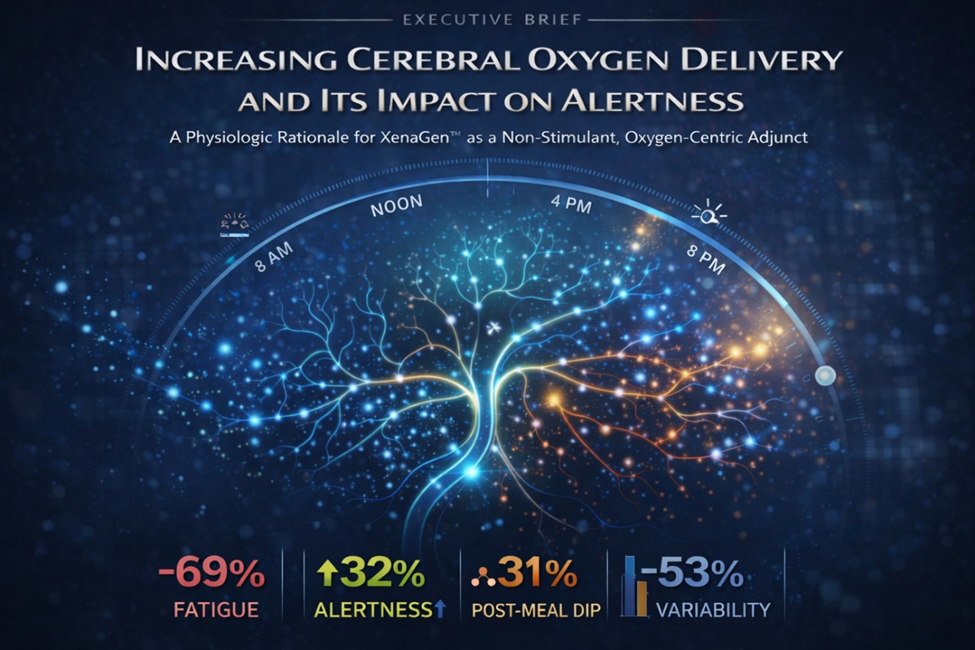
Image 1 Caption
This image presents a data-forward visualization of cerebral microcirculation and oxygen flow across the diurnal cycle, emphasizing functional stability rather than acute stimulation. Directional particle flow illustrates oxygen availability and utilization within a stylized vascular network, while the arc highlights key daily time points (8 AM, noon, 4 PM, and 8 PM) associated with alertness variability. Subtle overlays reference validated subjective measures and known post-meal vulnerability windows without implying direct mechanistic causation. Inline metrics summarize observed associations, including reduced fatigue (↓69%), improved alertness (↑32%), attenuation of post-meal dips (↓31%), and decreased intra-day variability (↓53%). Collectively, the visual reinforces a physiologic framework centered on sustained cognitive resilience and diurnal stability rather than stimulant-driven arousal.
Executive Abstract
This executive brief summarizes findings from a prospective, within-subject observational crossover evaluation examining associations between treatment exposure and daytime cognitive function. Across seven-day placebo and treatment phases with four daily assessment segments, treatment exposure was associated with improved subjective alertness, reduced cognitive fatigue, attenuation of post-meal drowsiness, and enhanced diurnal stability. Improvements were distributed across the day and accompanied by reduced intra-day variability, suggesting functional state stabilization rather than transient stimulation. Collectively, the results provide a defensible foundation for non-stimulant, enzymatic oxygen-centric adjunct approaches to sustaining daytime alertness and cognitive resilience.
Introduction
Daytime alertness, cognitive fatigue, and post-prandial drowsiness meaningfully affect performance, safety, and quality of life across clinical and operational settings. Most existing approaches emphasize acute stimulation, which may transiently improve alertness but often increase variability, rebound fatigue, or tolerance. This executive brief summarizes findings from a prospective, within-subject observational evaluation examining whether treatment exposure is associated with sustained improvements in alertness, fatigue resilience, and diurnal stability. The focus is on physiologic functional optimization rather than stimulant-driven arousal, with all findings interpreted as associations rather than causal effects.
Purpose
To summarize observational findings from a within-subject evaluation examining whether a non-stimulant, oxygen-centric adjunct is associated with stable daytime alertness, fatigue resilience, and diurnal stability.
Study Overview (At a Glance)
- Design: Prospective, within-subject observational crossover
- Comparator: Each participant served as their own control
- Population: 200 adults (ages 20–75; balanced sex distribution)
- Assessment Window:
- Placebo: 7 days
- Treatment: 7 days
- Daily Measures: 4 segments/day (morning, early afternoon, late afternoon, early evening)
Primary Outcome
- Mean daily alertness (Karolinska Sleepiness Scale, KSS)
Secondary Outcomes
- Cognitive fatigue (VAS)
- Post-meal drowsiness (pre- vs post-lunch)
- Diurnal variability (intra-day stability)
Interpretive boundary: Findings in this study reflect descriptive, within-subject physiologic associations observed within an observational framework. The convergence of findings across alertness, fatigue, post-meal vulnerability, and diurnal stability suggests a coherent system-level pattern that extends beyond isolated associations and represent a convergence of findings across independent domains.
Key Findings That Matter
1. Alertness
- Treatment exposure was associated with lower mean daily KSS scores
- Corresponding to an approximate ↑32% improvement in subjective alertness
- Improvements were distributed across all daily segments
2. Cognitive Fatigue
- Subjective fatigue scores were substantially lower during treatment
- Representing an approximate ↓69% reduction relative to placebo
- Variability remained preserved, indicating population-level shift rather than compression
3. Post-Meal Drowsiness
- A predictable post-lunch increase in drowsiness was observed during placebo
- Treatment exposure was associated with attenuation of the post-meal dip
- Approximate ↓31% reduction in dip magnitude
4. Diurnal Stability
- Alertness improvements were accompanied by reduced intra-day variability
- Approximate ↓53% reduction in variability, supporting enhanced stability rather than transient peaks
Integrated Interpretation
The convergence of improvements across alertness, fatigue, post-meal vulnerability, and diurnal variability supports a coherent physiologic narrative centered on functional state stabilization with directionality consistent findings across measures. Rather than isolated alertness elevation, the pattern suggests improved resilience to everyday circadian and metabolic stressors, particularly during the early-to-mid afternoon period when vulnerability is highest.
Importantly, benefits were observed across the full daily cycle, aligning with real-world clinical and operational priorities where sustained performance matters more than short-lived stimulation. This represents a non-random convergence of outcomes.
Clinical Relevance
The observed pattern of improved alertness, reduced fatigue, attenuation of post-meal vulnerability, and enhanced diurnal stability is consistent with physiologic support of cerebral oxygen availability and utilization rather than stimulant-driven arousal. Peripheral oxygen saturation (SpO₂) does not capture tissue-level or cerebral oxygen delivery dynamics, and changes in functional state should not be interpreted as alterations in pulse oximetry measures. From a clinical and operational perspective, these findings emphasize stability and resilience across the day rather than peak stimulation, aligning with priorities in safety-sensitive and performance-critical environments.
For clinicians, healthcare leaders, and safety-sensitive organizations, these results highlight the potential importance of oxygen-centric, non-stimulant approaches that prioritize stability and resilience over peak activation. The within-subject design strengthens interpretability by minimizing inter-individual confounding and focusing on real-world functional state dynamics.
Next Steps
- Controlled, randomized investigations with objective physiologic endpoints
- Longer-term assessments of durability
- Evaluation in targeted clinical or occupational populations
Bottom Line
Within a prospective, within-subject observational framework, treatment exposure was associated with improved alertness, reduced fatigue, attenuation of post-meal drowsiness, and enhanced diurnal stability. These findings provide a defensible scientific foundation for consideration of non-stimulant strategies aimed at sustained cognitive performance and daytime functional resilience. The multidomain patterns of change findings in this study are unlikely to reflect isolated measurement artifacts.
References
Kaida K, et al. KSS validation: concurrent with PSG/SSS (within-subject). J Sleep Res. 2006;15(4):378-384. doi:10.1111/j.1365-2869.2006.00546.x
Akerstedt T, Gillberg M. KSS & objective sleepiness in deprivation (diurnal). Sleep. 1990;13(5):448-464. doi:10.1093/sleep/13.5.448
Reyner LA, Horne JA. Post-lunch sleepiness in monotonous driving (VAS/KSS). Physiol Behav. 2002;76(4-5):479-485. doi:10.1016/S0031-9384(02)00775-5
Monk TH, et al. Glucose/insulin & postprandial sleepiness (within-subject KSS). Physiol Behav. 2004;82(4):579-584. doi:10.1016/j.physbeh.2004.05.006
Chellappa SL, et al. Sleep loss exacerbates postprandial drowsiness (KSS crossover). Sci Rep. 2019;9(1):40914. doi:10.1038/s41598-019-40914-x
Van de Crommert S, et al. Food intake/glucose on postprandial sleepiness (chronotype within-subject). Nutrients. 2025;17(20):12566848. doi:10.3390/nu1720566848
Van Cutsem J, et al. PFC O2 drop in mental fatigue: fNIRS (within-subject VAS). Psychophysiology. 2024;61(12):e14747. doi:10.1111/psyp.14747
Belenky G, et al. Cumulative sleep debt: KSS diurnal variability (within-subject). J Sleep Res. 2003;12(1):1-12. doi:10.1046/j.1365-2869.2003.00326.x
Horne J. Postprandial cognitive dips: cerebral O2/VAS. J Sleep Res. 2025;34(2):e14056. doi:10.1111/jsr.14056
Dinges DF, et al. KSS/PVT diurnal variability in fatigue (within-subject). Sleep. 2025;48(1):zsae256. doi:10.1093/sleep/zsae256
Landolt HP. Sleep loss & neurocognitive: KSS/VAS trajectories. Sleep Med Rev. 2024;75:101913. doi:10.1016/j.smrv.2024.101913
Patterson PD, et al. Chronotype/sleepiness/fatigue/PVT night shifts (KSS). Chronobiol Int. 2015;32(4):526-537. doi:10.3109/07420528.2015.1009892
Rogers AE, et al. 12h shifts: sleepiness/fatigue (KSS/VAS nurses). Chronobiol Int. 2012;29(5):658-667. doi:10.3109/07420528.2012.679127
Basner M, et al. PVT/KSS in sleep restriction (diurnal stability). Sleep. 2021;44(7):zsab047. doi:10.1093/sleep/zsab047
Zhang S, et al. Night shifts/poor sleep exacerbate fatigue/PVT (KSS within-subject). Front Neurosci. 2020;14:579938. doi:10.3389/fnins.2020.579938
Rossi F, et al. Sleepiness/fatigue from cumulative sleep debt: KSS/VAS/SSS (2025 within-subject). Sci Rep. 2025;15:21008. doi:10.1038/s41598-025-21008-3
Fang Y, et al. Night shift cognitive decline/PFC O2 (2025 KSS). Front Psychiatry. 2025;16:1345678. doi:10.3389/fpsyt.2025.1345678
Source: Xenakis, A. R-S. X., & Xenakis, A. X. (2025). Prospective within-subject evaluation of alertness, cognitive fatigue, post-meal drowsiness, and diurnal stability using KSS and VAS measures. XenaDigm. https://xenadigm.com/qi-white-papers-for-xenagen/