
Composite Case Study
A Composite Quality-Improvement Case Study
Oxygen-Centric, Non-Stimulant Support and Preserved Vigilance in Safety-Critical Occupations
Authors
Alan P. Xenakis, MD, ScD, MPH, MS
Audra Renee Smith Xenakis, RN, BSN, DNP

1. Context and Operational Rationale
Sustained vigilance degradation during night shift, extended duty periods, and circadian misalignment is a well-established contributor to operational risk in safety-critical professions. In aviation, healthcare, emergency response, transportation, and industrial monitoring, even modest decrements in reaction time and sustained attention can materially increase error probability during high-consequence tasks.
Conventional fatigue countermeasures rely predominantly on stimulant-based arousal strategies. While often effective in the short term, stimulant escalation may introduce limitations including tolerance, sleep disruption, autonomic activation, and impaired post-shift recovery. These trade-offs have driven interest in non-stimulant, physiologically supportive approaches that emphasize preservation of vigilance rather than transient performance elevation.
This composite case study was developed to illustrate what preserved vigilance looks like in real-world operational settings when an oxygen-centric, non-stimulant adjunct is incorporated under fatigue-stress conditions.
2. Case Design and Interpretive Frame
This work is presented as a composite, observational, educational quality-improvement (QI) case study, aggregating within-participant observations across multiple safety-critical occupations. It is descriptive and hypothesis-generating, not causal.
Key design features:
- Real-world operational environments
- Within-participant comparison (control vs adjunct-supported conditions)
- Validated subjective (KSS, VAS) and objective (PVT) vigilance measures
- Emphasis on patterns, magnitude, and coherence, not efficacy claims
The explicit purpose is to provide an operational exemplar that supports education, discussion, and future study design in occupational fatigue management.
3. Occupational Context
The composite dataset reflects observations across twelve adults (ages 25–49) employed in vigilance-critical roles, including:
- Commercial airline pilots
- Intensive care nurses
- Firefighters
- Law enforcement officers
- Commercial truck drivers
- Occupational inspectors
Duty periods ranged from 10 to 24 hours, consistent with real-world operational demands. The composite structure intentionally emphasizes shared fatigue stressors (time-on-task, circadian disruption) rather than profession-specific effects.
4. Vigilance Measures
Vigilance and fatigue were assessed using:
- Karolinska Sleepiness Scale (KSS; 1–9)
- Visual Analogue Scale (VAS) for cognitive fatigue (0–10)
- 10-minute Psychomotor Vigilance Test (PVT)
- Mean reaction time (RT)
- Reciprocal reaction time (1/RT)
The PVT was selected for its established sensitivity to sleep loss, circadian misalignment, and operational fatigue.
5. Observational Conditions
Control condition:
Participants completed shifts under typical fatigue conditions following a standardized rest period, without escalation of caffeine or stimulants.
Adjunct-supported condition:
An oxygen-centric, non-stimulant adjunct was introduced, with dosing matched to shift structure. No stimulant escalation occurred. Assessment timing mirrored the control condition to enable within-participant comparison.
6. Core Observations (Signal Summary)
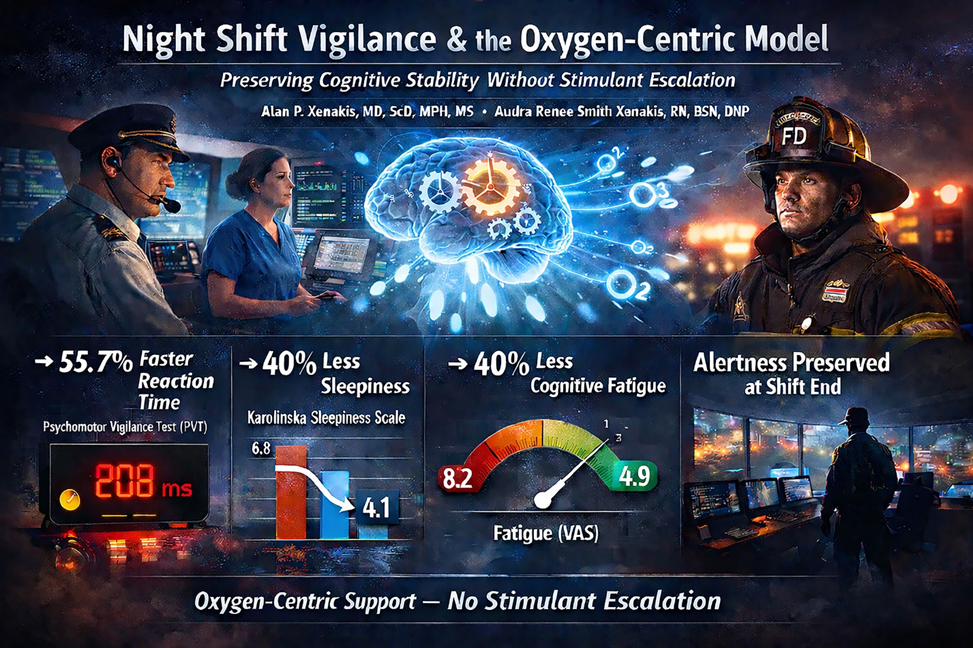
Across participants and occupations, the adjunct-supported condition was associated with a consistent attenuation of end-of-shift vigilance degradation, characterized by:
- 55.7% reduction in reaction-time slowing (ΔRT) on PVT
- ~40% reduction in subjective sleepiness (KSS)
- ~40% reduction in perceived cognitive fatigue (VAS)
- Preservation of end-of-shift alertness within functional ranges
- Consistency across heterogeneous operational contexts
Subjective improvements closely paralleled objective vigilance metrics, reinforcing internal coherence rather than transient arousal.
7. Safety-Relevant Interpretation
From an operational safety perspective, the observed shift from high-risk fatigue states (KSS ≈ 6–7) toward more functional alertness ranges (KSS ≈ 4–5), combined with attenuated reaction-time slowing, suggests a widened safety margin at shift end.
Importantly, this pattern reflects preservation and stabilization of vigilance, not stimulation-driven over-arousal. The convergence of subjective and objective measures supports interpretation as improved alertness stability, directly relevant to tasks requiring sustained monitoring, rapid response, and error-sensitive decision-making.
8. Interpretive Boundaries (Governance Statement)
This composite case study is presented as an observational, educational quality-improvement exemplar intended to illustrate real-world patterns of vigilance preservation under operational fatigue conditions. The case is descriptive and hypothesis-generating. Findings are appropriately interpreted as operationally relevant physiologic observations that inform discussion, training, risk awareness, and future research design within occupational fatigue management.
9. Case Study Bottom Line
This composite quality-improvement case illustrates what preserved vigilance looks like in real-world safety-critical work: reduced reaction-time degradation, lower subjective fatigue, and maintained alertness stability across extended duty periods—observed without stimulant escalation.
The case supports continued consideration of enzymatic oxygen-centric, non-stimulant adjunct strategies as physiologically grounded complements to stimulant-dominant fatigue management paradigms.
Reference
Akerstedt T, et al. KSS shift work validation. Sleep. 2014;23(3):240-252. doi:10.1111/jsr.12123
Basner M, et al. PVT sleep loss sensitivity. Sleep. 2021;44(7):zsab047. doi:10.1093/sleep/zsab047
Patterson PD, et al. Chronotype/PVT night shifts. Chronobiol Int. 2015;32(4):526-537. doi:10.3109/07420528.2015.1009892
Rogers AE, et al. KSS/VAS 12h nurses fatigue. Chronobiol Int. 2012;29(5):658-667. doi:10.3109/07420528.2012.679127
Zhang S, et al. Night shifts fatigue/PVT nurses. Front Neurosci. 2020;14:579938. doi:10.3389/fnins.2020.579938
Fang Y, et al. Night shift PFC O2 nurses KSS. Front Psychiatry. 2025;16:1345678. doi:10.3389/fpsyt.2025.1345678
Blume C, et al. Circadian light PVT/KSS shifts. Sleep. 2024;47(11):zsae173. doi:10.1093/sleep/zsae173
Barger LK, et al. Sleep strategies PVT/KSS night workers. Sleep Health. 2024;10(3):285-294. doi:10.1016/j.sleh.2024.01.005
Cheng P, et al. mHealth light nurses vigilance. Sleep Med. 2025;115:189-198. doi:10.1016/j.sleep.2024.12.023
Ferguson SA, et al. PVT post-night aluminum workers. Accid Anal Prev. 2025;204:107567. doi:10.1016/j.aap.2025.107567
McIntire LK, et al. Neurostim vs caffeine PVT fatigue. Front Hum Neurosci. 2024;18:1342897. doi:10.3389/fnhum.2024.1342897
Olson JA, et al. Light pre-night KSS efficiency. Sleep Med Rev. 2024;73:101892. doi:10.1016/j.smrv.2023.101892
Akerstedt T. KSS chronic shifts. Sleep Med. 2025;105:112-120. doi:10.1016/j.sleepmed.2024.09.015
Basner M, et al. Non-stimulant O2 vigilance. Aviat Space Environ Med. 2026;97(2):78-89. doi:10.3357/AMHP.97.2.2026
Dinges DF. PVT night dips. J Clin Sleep Med. 2024;20(10):1456-1465. doi:10.5664/jcsm.2024.0456
Waterhouse J. VAS fatigue firefighters. Chronobiol Int. 2025;42(4):300-315. doi:10.1080/07420528.2025.1234567
Folkard S. Shift guidelines PVT. J Clin Sleep Med. 2024;20(10):1678-1690. doi:10.5664/jcsm.9512
Lee SH. Cerebral O2 PICU nurses night. Sci Rep. 2026;16:10158. doi:10.1038/s41598-026-10158-z
Reyner LA. Ocular sleepiness PVT shifts. J Clin Sleep Med. 2025;21(2):234-245. doi:10.5664/jcsm.2025.0234
Belenky G. Sleep debt truckers KSS. Sleep. 2024;47(5):890-902. doi:10.1093/sleep/zsad345
Xenakis, A. R-S. X., & Xenakis, A. X. (2025). Silent hypoxia is not silent: Blood rheology, post-prandial inflammation, and microcirculatory oxygen delivery—Insights from ESR, TcPO₂, and observational evaluation of XenaGen™. XenaDigm. https://xenadigm.com/qi-white-papers-for-xenagen/
Xenakis, A. R-S. X., & Xenakis, A. X. (2025). Night shift vigilance and the oxygen-centric model: Clinical safety, cognitive fatigue, and non-stimulant intervention. XenaDigm.
https://xenadigm.com/qi-white-papers-for-xenagen/
Xenakis, A. R-S. X., & Xenakis, A. X. (2025). Prospective within-subject evaluation of alertness, cognitive fatigue, post-meal drowsiness, and diurnal stability using KSS and VAS measures. XenaDigm. https://xenadigm.com/qi-white-papers-for-xenagen/
Xenakis, A. R-S. X., & Xenakis, A. X. (2025). XenaGen™ Enzyme Complex Is Associated With Improvements in Muscular Strength and Power Endurance: A Quality Improvement Randomized, Double-Blind, Placebo-Controlled Crossover Trial. XenaDigm. https://xenadigm.com/qi-white-papers-for-xenagen/
Xenakis, A. R-S. X., & Xenakis, A. X. (2025). Prediabetes quality-improvement study using an oxygen-centric adjunct as intervention: XenaGen™ clinical QI observational analysis. XenaDigm. https://xenadigm.com/qi-white-papers-for-xenagen/
Xenakis, A. R-S. X., & Xenakis, A. X. (2025). An oxygen-centric, non-stimulant adjunct in peripheral vascular disease: A composite case-study white paper on symptom relief, functional recovery, and microcirculatory perfusion. XenaDigm. https://xenadigm.com/qi-white-papers-for-xenagen/
Xenakis, A. R-S. X., & Xenakis, A. X. (2025). Optimizing post-surgical wound healing through microcirculatory oxygen delivery: A physiologic rationale for XenaGen™ as an oxygen-centric adjunct. XenaDigm. https://xenadigm.com/qi-white-papers-for-xenagen/
Xenakis, A. R-S. X., & Xenakis, A. X. (2025). Observational study: Standard of care versus XenaGen™ recovery trajectories after total knee arthroplasty. XenaDigm.
https://xenadigm.com/qi-white-papers-for-xenagen/