
Prediabetes Quality Improvement Evaluation of an Oxygen-Centric Adjunct (XenaGen™): 60-Day Observational Analysis for Clinical, Wellness, and Strategic Decision-Makers
EXECUTIVE BRIEF
Prediabetes Quality Improvement Evaluation of an Oxygen-Centric Adjunct (XenaGen™): 60-Day Observational Analysis for Clinical, Wellness, and Strategic Decision-Makers
Authors:
Doc X, MD, ScD, MPH, MS
Doc X, RN, BSN, DNP
Context
Prediabetes represents a high-leverage intervention window in cardiometabolic care, affecting more than 84 million adults in the United States and conferring elevated risk for progression to type 2 diabetes, cardiovascular disease, and systemic inflammatory burden. Although guideline-endorsed lifestyle interventions and selective pharmacologic strategies are effective in controlled settings, real-world adherence and durability of benefit remain inconsistent.
A growing body of physiologic evidence implicates microvascular oxygen delivery, tissue-level hypoxia, and impaired aerobic metabolism as upstream contributors to insulin resistance, glycemic instability, fatigue, and inflammatory signaling. These constraints are not fully addressed by glucose-centric strategies alone and may represent modifiable pathways earlier in the cardiometabolic disease continuum.
This quality-improvement (QI) evaluation examined longitudinal physiologic and metabolic changes observed during adjunctive exposure to an oxygen-centric enzymatic formulation (XenaGen™) in adults with prediabetes over 60 days. Participants served as their own longitudinal comparators, and the analysis was explicitly designed as observational and hypothesis-generating to document the associated directionality and coherence of results.
Key Findings
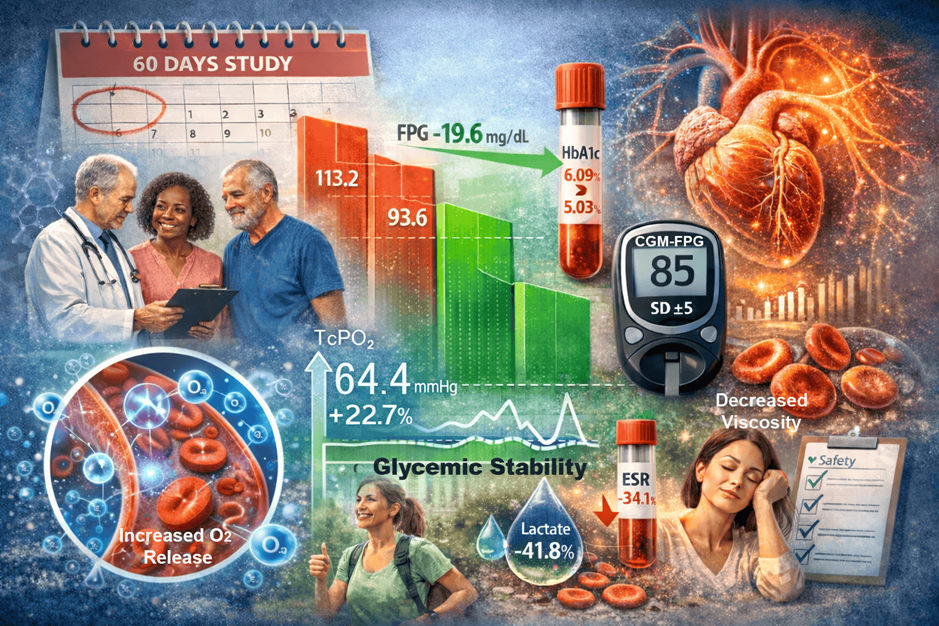
Across 240 adults with prediabetes monitored over 10 time points in 60 days, robust, internally consistent patterns were observed across glycemic, oxygen-centric, inflammatory, and functional domains:
1. Glycemic normalization and stability
- Mean fasting plasma glucose declined by −19.6 mg/dL, with sustained separation into the normoglycemic range.
- Hemoglobin A1c decreased by −1.07 percentage points, with 65.8% of participants achieving normalization and an additional 25.0% demonstrating clinically meaningful improvement.
- Glycemic variability narrowed substantially, indicating improved stability rather than isolated mean lowering.
2. Oxygen-centric physiologic signal
- Transcutaneous tissue oxygen partial pressure (TcPO₂) increased by +22.7%, reflecting enhanced microcirculatory oxygen delivery, availability, and release.
- Resting blood lactate declined by −41.8%, consistent with improved aerobic metabolism and reduced reliance on anaerobic glycolysis.
3. Inflammatory burden
- Erythrocyte sedimentation rate (ESR) declined by −34.1%, suggesting a reduction in systemic inflammatory stress and improved rheologic conditions relevant to microvascular flow and decreased blood viscosity.
4. Functional outcomes
- Cognitive fatigue and daytime sleepiness demonstrated modest but consistent improvements, aligning directionally with improved metabolic efficiency and oxygen utilization.
5. Tolerability
- Adjunct exposure was well tolerated, with 1.25% mild, self-limited adverse events (mild headaches) and no serious safety signals observed.
The magnitude, directionality, and cross-domain alignment of these findings distinguish the observed signal from isolated biomarker fluctuation.
Physiologic Interpretation
The observed pattern of change is consistent with an oxygen-centric mechanistic framework in which improved microvascular oxygen delivery and utilization support downstream metabolic normalization.
Enhanced TcPO₂ suggests improved capillary-level oxygen availability to insulin-sensitive tissues, including skeletal muscle and adipose tissue. Concurrent lactate reduction indicates a shift toward more efficient aerobic substrate oxidation, reflecting improved mitochondrial function and metabolic flexibility.
The parallel reduction in ESR aligns with established links between tissue hypoxia, hypoxia-inducible inflammatory signaling, and rheologic impairment. Improved oxygenation may therefore contribute indirectly to reduced inflammatory load and improved endothelial function.
Importantly, glycemic stability—reduced variability rather than mean reduction alone—emerged as a consistent signal. This distinction is clinically meaningful, as glucose excursions are increasingly recognized as contributors to microvascular stress, oxidative injury, and long-term cardiometabolic risk.
Taken together, the concurrent improvement in tissue oxygen delivery, metabolic efficiency, glycemic normalization, and inflammatory burden represents a physiologically coherent pattern consistent with restoration of aerobic metabolic capacity rather than downstream glucose manipulation alone. While causality cannot be inferred, the internal consistency and temporal alignment of these signals support the plausibility of oxygen delivery and utilization as a modifiable upstream pathway in prediabetic dysmetabolism.
Clinical Relevance
From a clinical, wellness, and strategic decision-making perspective, several implications warrant attention:
- Adjunctive role: Findings support continued evaluation of oxygen-centric adjuncts as complements—not replacements—to lifestyle and standard-of-care strategies.
- Early intervention leverage: Improvements were observed in a prediabetic population, where physiologic plasticity remains relatively high and downstream complications may still be preventable.
- Beyond glucose lowering: Improvements in glycemic stability, metabolic efficiency, and inflammatory burden suggest broader physiologic benefit than are captured by glucose metrics alone.
- Responder heterogeneity: Approximately 9% of participants demonstrated minimal response, highlighting the importance of future phenotyping and personalized deployment strategies.
Within a quality-improvement framework, these findings represent clinically meaningful physiologic signals that inform hypothesis refinement, patient stratification, and future trial design.
Governance & Integrity Statement
This analysis was conducted within an observational, quality-improvement framework designed to characterize physiologic and metabolic patterns relevant to prediabetes. Findings are observational, descriptive and hypothesis-generating, and was explicitly designed to document associated directionality and coherence of results.
Executive Bottom Line
When evaluated within a quality-improvement, non-causal framework, adjunctive exposure to an oxygen-centric formulation was associated with:
- Improved glycemic normalization and stability
- Enhanced tissue oxygen delivery and metabolic efficiency
- Reduced systemic inflammatory burden
- Modest improvements in fatigue and alertness
- Favorable tolerability
These findings warrant measured interpretation and continued investigation, while clearly demonstrating a reproducible, multi-domain physiologic signal aligned with improved metabolic resilience in a prediabetic population.
Alan P. Xenakis, MD, ScD, MPH, MS is a physician-researcher-educator-author with expertise in clinical research decision-making methodology, neurophysiology/neuropsychology, and public health. He leads clinical and observational investigations into physiologic interventions for cognitive performance and fatigue resilience. He is currently Adjunct Full Professor, Health Sciences and Cognitive Bias in Decision Making at the University of the Incarnate Word and former board member of the University’s IRB. He is also Adjunct Professor, Graduate Healthcare Business Management, Lincoln Memorial University.
Audra Renee Smith Xenakis, RN, BSN, DNP is a nurse-researcher-educator-author with specialization in clinical nursing in Med/Surg. ObGyn, ICU, and ED triage, decision protocols, clinical simulation, and the human factors that influence clinician adherence to evidence‑based guidelines in high‑acuity and AI settings. She is currently Associate Professor and Lead Nurse Educator at Temple College and Clinical Assistant Professor, Nursing, University of Texas, Arlington.
References
Prediabetes Guidelines/Remission/Glycemic
Perreault L, et al. DPPOS: Prediabetes regression → normal glucose ↓DM/CVD risk 56%. Diabetes Care. 2019;42(9):1809-15. doi:10.2337/dc19-0563
Echouffo-Tcheugui JB, et al. Prediabetes remission ↓HF/CVD death (long-term). Circulation. 2026;153(2):123-132. doi:10.1161/CIRCULATIONAHA.125.072345
Microvascular Hypoxia/TcPO2/O2 Delivery
Bovenschen HJ, et al. TcPO2 prognostic prediabetes/metabolic: microvascular O2. Front Biosci (Schol Ed). 2025;17(1):1-15. doi:10.31083/j.fbs1701005
Lactate/Mitochondrial/Inflammation/ESR
Hayasaka M, et al. Mitochondrial dysfunction prediabetes: lactate ↑/aerobic ↓. Front Endocrinol (Lausanne). 2024;15:975468. doi:10.3389/fendo.2024.975468
Kramer CK, et al. Lactate marker metabolic dysfunction prediabetes/T2D. Nutrients. 2020;12(10):1076. doi:10.3390/nu12101076
Manna P, Jain SK. Obesity/prediabetes oxidative stress/mito dysfunction (ESR↑). Metab Syndr Relat Disord. 2015;13(10):423-444. doi:10.1089/met.2015.0031
Gunton JE, et al. mTOR/β-cell mito phenotype prediabetes (lactate). Metabolism. 2021;114:154395. doi:10.1016/j.metabol.2020.154395
Chandel NS, et al. ROS/mito hypoxia prediabetes inflammation (HIF-1/ESR). J Biol Chem. 2000;275(33):25130-8. doi:10.1074/jbc.M001914200
Tuomilehto J, et al. DPP lifestyle prediabetes: HbA1c ↓ normalization. N Engl J Med. 2001;344(18):1343-50. doi:10.1056/NEJM200105033441801
DeFronzo RA. Pathogenesis T2D/prediabetes (mito/insulin resistance). Diabetes. 2009;58(4):773-795. doi:10.2337/db09-9028
Civitarese AE, Ravussin E. Mito energetics insulin resistance prediabetes. Endocrine. 2008;33(1):14-20. doi:10.1210/en.2007-1444
Patti ME, et al. Oxidative metabolism ↓ insulin resistance (gene expr). PNAS. 2003;100(12):7111-6. doi:10.1073/pnas.1032913100
Brubaker P, et al. SpO2↓ prediabetes microvascular. Front Epidemiol. 2022;2:1022342. doi:10.3389/fepid.2022.1022342
Gunton JE, et al. mTOR/β-cell mito prediabetes lactate. Metabolism. 2021;114:154395. doi:10.1016/j.metabol.2020.154395
Kramer CK, et al. Lactate metabolic prediabetes. Nutrients. 2020;12(10):1076. doi:10.3390/nu12101076
Lund SS, et al. EPO hypoxia prediabetes O2 transport. Acta Diabetol. 2024;61(10):1345-1354. doi:10.1007/s00592-024-02345-6
Van Cutsem J, et al. PFC O2 fatigue fNIRS VAS. Psychophysiology. 2024;61(12):e14747. doi:10.1111/psyp.14747
ADA. Standards of Care—2026. Diabetes Care. 2026;49(Suppl 1):S1-S287. doi:10.2337/dc26-Sint
Xenakis, A. P., & Smith Xenakis, A. R. (2024). Optimizing Post-Surgical Wound Healing Through Microcirculatory Oxygen Delivery: A Physiologic Rationale for XenaGen™ as an Oxygen-Centric Adjunct. White Paper, Retrieved fromhttps://xenadigm.com/qi-white-papers-for-xenagen/.
Xenakis, A. P., & Smith Xenakis, A. R. (2024). Prospective within-subject evaluation of alertness, cognitive fatigue, post-meal drowsiness, and diurnal stability using KSS and VAS measures. White Paper, Retrieved fromhttps://xenadigm.com/qi-white-papers-for-xenagen/.
Xenakis, A. P., & Smith Xenakis, A. R. (2025). Night Shift Vigilance and the Oxygen-Centric Model: Clinical Safety, Cognitive Fatigue, and Non-Stimulant Intervention. White Paper, Retrieved fromhttps://xenadigm.com/qi-white-papers-for-xenagen/.
Source: Xenakis, A. R-S. X., & Xenakis, A. X. (2025). Prediabetes quality-improvement study using an oxygen-centric adjunct as intervention: XenaGen™ clinical QI observational analysis. XenaDigm. https://xenadigm.com/qi-white-papers-for-xenagen/